
Your car made a loud roaring sound this morning. Or maybe you noticed a strange burning smell. Maybe your gas mileage has gotten worse. All of these can point to one thing: your exhaust system might be in trouble. But the big question is, should you repair it or fully replace it? That is what this guide is here to help you figure out.
Understanding your exhaust system can save you money, keep you safe, and help your car run better. Let’s go through it all in simple terms.
What Does the Exhaust System Actually Do?
The exhaust system is not just about the pipe you see at the back of the car. It is a full system that works every time your engine runs. It takes the harmful combustion gases from the engine and moves them safely out of the car through the tailpipe.
It also reduces engine noise, helps your engine run at the right temperature, and lowers harmful emissions before they leave the car. The main parts include the exhaust manifold, catalytic converter, resonator, muffler, oxygen sensors, pipes, and hangers.
Each part has a job. When one fails, the others start to feel the strain too. That is why catching problems early really matters.
How Long Does an Exhaust System Last?
Honestly, this depends a lot on where you drive and how you drive. I have seen cars with exhausts that lasted 15 years and cars where the system was almost done by year five. It really varies.
According to Halfords Auto Care, modern exhausts made from stainless steel or chrome can last the full life of the car if not damaged. But standard non-stainless systems tend to last around five years.
Short trips hurt the exhaust more than long drives. Why? Because short trips do not give the system enough time to heat up and dry out. Moisture stays inside, which causes condensation and speeds up corrosion. If you mostly drive around town, your exhaust wears out faster.
Road salt in winter climates also attacks the metal hard. If you live somewhere cold and snowy, check your exhaust every year without fail.
Warning Signs Your Exhaust System Has a Problem
Your car will usually tell you something is wrong before it becomes a big expensive mess. You just have to know what to look and listen for. Here are the main warning signs to watch out for.
Loud or Roaring Engine Noise
This is the most common sign. If your car suddenly sounds louder than normal, especially when you press the gas, there is likely an exhaust leak or a failing muffler. The muffler’s job is to keep things quiet. When it starts to fail, you will know.
Rattling Sounds
A rattling or clanking sound usually means something is loose. It could be a broken hanger, a cracked heat shield, or a loose catalytic converter. If you hear rattling when you start the car or go over bumps, get it checked soon.
Burning Smell Inside the Car
A burning smell is a serious warning. It often means the manifold gasket has failed and hot exhaust fumes are leaking near plastic wiring or engine parts. That heat can cause those parts to burn. Do not ignore this sign.
Lower Fuel Efficiency
Noticed you are filling up the gas tank more often? An exhaust leak can trick the oxygen sensor into sending a wrong signal. The engine then burns more fuel than needed. A drop in miles per gallon can be an early clue.
Vibrations in the Steering Wheel or Seat
If you feel vibrations in your steering wheel, gas pedal, or even your car seat, that is not normal. It could mean a big exhaust leak or a rusty pipe that is about to break. Vibrations mean the problem is already quite serious.
Visible Rust or Damage
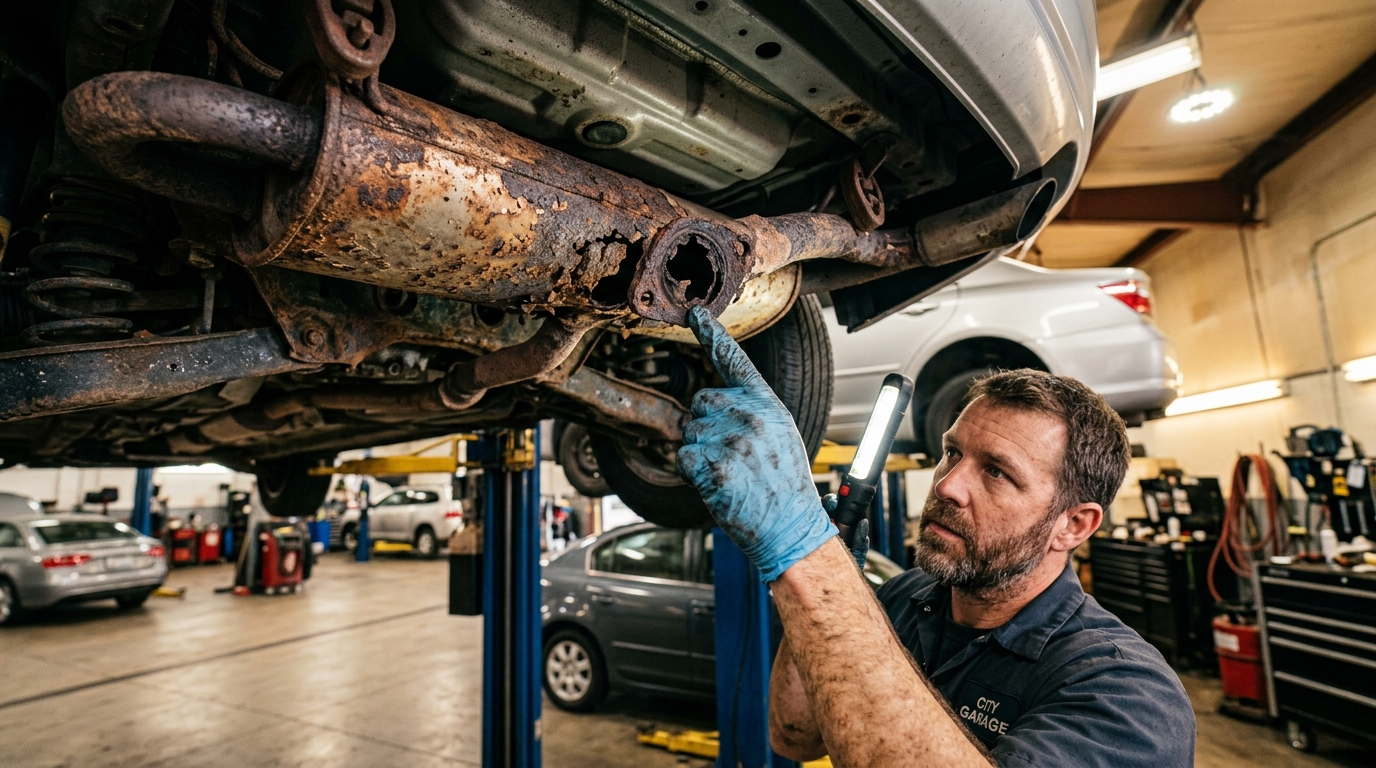
Take a look under your car once in a while. If you see black spots, these are carbon deposits from leaks. Heavy rust or visible holes in the exhaust pipe are clear signs that something needs attention fast.
Exhaust Fumes Inside the Cabin
This is the most dangerous sign of all. If you can smell exhaust fumes or carbon monoxide inside the car while driving, pull over immediately. Carbon monoxide is colorless, odorless in large amounts, and deadly. Even a small smell inside the cabin is an emergency.
Check Engine Light
Your check engine light can come on for many reasons, but one of them is a failing catalytic converter or a faulty oxygen sensor. Never ignore this light. Get a diagnostic scan done to find out what is going on.
When Repair Makes More Sense Than Replacement
I want to be honest here: not every exhaust problem means you need a brand new system. In many cases, a targeted repair is all you need, and it costs a lot less.
Repair is the right call when the damage is small and limited to one area. For example, if there is a small pipe leak or a loose joint, a mechanic can often seal or weld that section without touching the rest. A broken hanger or bracket is another easy fix that does not require replacing anything major.
If only one oxygen sensor has gone bad, replacing just that sensor is simple and inexpensive. Same goes for a leaking manifold gasket. These repairs are focused and affordable.
Repair makes sense when:
- The damage is in one isolated spot
- The rest of the system looks and sounds healthy
- The car is newer and the exhaust is mostly in good shape
- A bracket, clamp, or sensor is the only thing that has failed
When You Should Replace the Entire Exhaust System
There are times when patching things up is just throwing good money at a bad problem. A full exhaust system replacement makes more sense in certain situations.
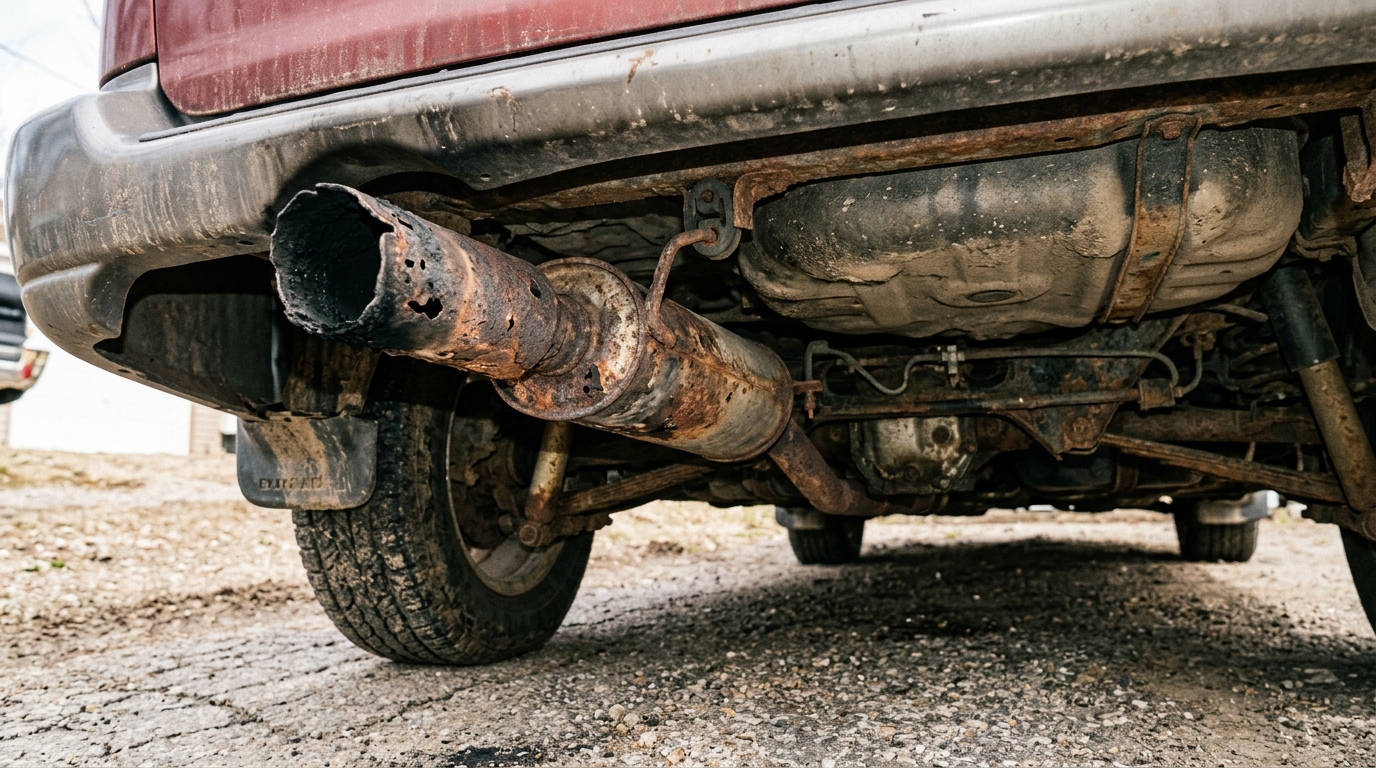
If your exhaust is old and heavily rusted, fixing one section often just moves the problem somewhere else. Age, heat, and road moisture work together over time, so if one part is rusted through, the rest is probably close behind. Replacing the whole thing at once saves you from repeat visits to the shop.
A failing catalytic converter almost always means full replacement of that unit. Catalytic converters are expensive parts, and once they break down, they cannot be repaired. If the one on your car has failed, you need a new one.
If you have a corrosion hole in the pipe rather than just surface rust, that is serious. Holes let combustion gases and carbon monoxide escape before they reach the tailpipe. That is a vehicle safety issue, not just a noise issue.
| Situation | Repair or Replace? |
| Small leak in one pipe section | Repair |
| Loose bracket or hanger | Repair |
| Faulty oxygen sensor | Repair (replace sensor) |
| Heavy rust across multiple sections | Replace |
| Failed catalytic converter | Replace |
| Corrosion holes in the pipe | Replace |
| Muffler completely broken | Replace |
| Fumes entering the cabin | Replace immediately |
How Much Does Exhaust Repair or Replacement Cost?
Cost is always the big question. And the answer really depends on what is broken and what kind of car you have.
Small repairs like welding a crack, replacing a clamp, or fixing a hanger can cost anywhere from $50 to $200. These are the easy wins. A new muffler alone typically runs between $150 and $400, including labor. A catalytic converter replacement is the priciest fix, often between $900 and $2,500, depending on the vehicle make and year.
A full exhaust system replacement on a standard car usually ranges from $300 to $1,200. Performance vehicles cost more. Always get at least two quotes from different shops before agreeing to the work.
Quick Tip: According to the U.S. Environmental Protection Agency (EPA), a properly functioning catalytic converter is required by law in the US and directly affects your car’s emissions output. A failed one not only hurts your engine but can make your car illegal to drive on public roads.
Is It Safe to Drive with a Damaged Exhaust?
Short answer: It depends on the damage. But honestly, I would not take chances with this one. An exhaust leak that lets carbon monoxide into the cabin is a life-safety issue. You cannot see it, and in high enough amounts, you cannot smell it either.
A loose muffler or minor surface rust with no holes? You can probably drive for a few days until your appointment, but do not delay. A fully detached exhaust pipe dragging on the road? Stop the car. A pipe on the ground is a hazard to you and to other drivers.
According to the U.S. Centers for Disease Control and Prevention (CDC), carbon monoxide poisoning from vehicle exhaust causes hundreds of deaths each year in the United States. The risk is real, especially if you drive with windows up in cold weather. Never brush off any smell of exhaust inside your car.
Simple Tips to Make Your Exhaust System Last Longer
Taking a little care of your exhaust can add years to its life. Here are some things that actually work.
Try to take longer drives every once in a while. If you only ever drive five minutes to the store, moisture builds up inside the system and causes rust from the inside out. A 20 to 30-minute highway drive helps burn off that moisture and keeps the system healthier.
Avoid hitting potholes hard. Direct impacts can crack pipes, bend hangers, and break joints. Drive around them when you safely can. Also, if you live in a snowy area, wash under your car more often in winter. Road salt is brutal on metal.
During your regular service, ask your mechanic to do a quick visual check on the exhaust. Early signs of corrosion or small cracks are easy and cheap to fix if caught early. Waiting until there is a loud noise or a bad smell means the damage is already serious.
Conclusion
So, when should you repair or replace your car’s exhaust system? The answer comes down to how bad the damage is, how old your car is, and whether the issue is in one spot or spread across the whole system.
If the damage is small and the rest of the exhaust looks fine, a simple repair works well and saves you money. But if you see heavy rust, multiple cracks, a failed catalytic converter, or you are smelling exhaust fumes inside the car, do not wait. A full replacement is the safer and smarter choice.
Your exhaust system protects your health, keeps your engine running right, and helps the environment. It is one of those parts of the car that is easy to forget about, until it goes wrong. Take care of it, and it will take care of you. Have questions about your exhaust? I would love to hear your experience in the comments below!
Frequently Asked Questions (FAQs)
1. How do I know if my exhaust system needs repair or full replacement?
If the damage is small and in one area, like a loose clamp or a minor pipe leak, a repair is usually enough. But if you see heavy rust, corrosion holes, a failed catalytic converter, or you smell exhaust fumes inside the car, full replacement is the right move. A mechanic can inspect and give you the best answer for your specific car.
2. Can I drive my car with an exhaust leak?
It depends on how bad the leak is. A very minor surface leak with no fumes entering the cabin can wait a day or two for a repair. But if you smell exhaust fumes or carbon monoxide inside the car, stop driving immediately. This is a serious health risk and needs to be fixed right away.
3. How long does a car exhaust system last?
A modern stainless steel exhaust system can last the lifetime of the car if it is not damaged. Standard systems usually last around five years. Driving habits, road conditions, and climate all affect this. Short trips, potholes, and road salt in winter all shorten the lifespan of the exhaust.
4. What is the most expensive part of an exhaust system to replace?
The catalytic converter is the most expensive part. Depending on your car’s make and model, a replacement can cost between $900 and $2,500. This is because it uses precious metals to clean combustion gases before they leave through the tailpipe. It cannot be repaired, only replaced.
5. Can a bad exhaust system affect my fuel economy?
Yes, it can. An exhaust leak can send a wrong signal to the oxygen sensor, which causes the engine to burn extra fuel. This drops your fuel efficiency and means you fill up the tank more often. If your miles per gallon have dropped without any other change, it is worth getting the exhaust checked.