

Living in Huntsville means your car works hard to keep you cool in blistering summers and warm during chilly winters. Your car’s A/C and heating system is not just about comfort; it’s a lifeline when temperatures hit extremes. I want to help you keep that system running strong for years.
Why Your Car’s A/C and Heating System Needs Extra Care in Huntsville
Huntsville sits in the Tennessee Valley, and if you’ve spent a summer here, you know the heat doesn’t play around. Temperatures can soar past 95 degrees, and the humidity makes it feel even hotter. Your car’s A/C system has to fight this heat every single day.
I’ve seen what happens when people skip maintenance. A friend of mine ignored his A/C until it quit working during a July road trip. He spent two hours in a hot car waiting for a tow truck. That’s not something you want to experience.
Winter in Huntsville is milder than up north, but we still get cold snaps. Your heating system needs to work when temperatures drop into the 20s or 30s. A broken heater isn’t just uncomfortable; it’s a safety issue if your windshield fogs up.
Huntsville’s Extreme Weather Puts Extra Stress on Your System
Summer heat makes your compressor work overtime. The hotter it is outside, the harder your system pushes to cool down your car. This constant strain wears out parts faster than in cooler climates.
Your refrigerant can also lose pressure when it’s hot. The heat causes tiny amounts to leak through rubber seals and hoses. Over time, your A/C gets weaker.
In winter, cold air makes engine oil thicker. This puts extra load on your battery and can affect how fast your heater warms up. Ice can form inside your HVAC system if moisture builds up.
How Alabama’s Climate Affects Your HVAC Components
Alabama’s humidity is rough on cars. Moisture gets into your cabin air filter, your evaporator coils, and even your heater core. This can cause mold growth and those musty smells you sometimes notice.
The heat also breaks down rubber parts faster. Your serpentine belt, which powers your A/C compressor, can crack and dry out. Hoses that carry coolant can develop leaks.
I learned this the hard way when my own car’s heater stopped working one November. A mechanic told me the thermostat had stuck open because old coolant had turned acidic. A simple coolant change could have saved me $400 in repairs.
Understanding How Your Car’s Heating and Cooling System Works
Before you can take care of your system, you need to know how it works. Don’t worry, I’ll keep this simple.
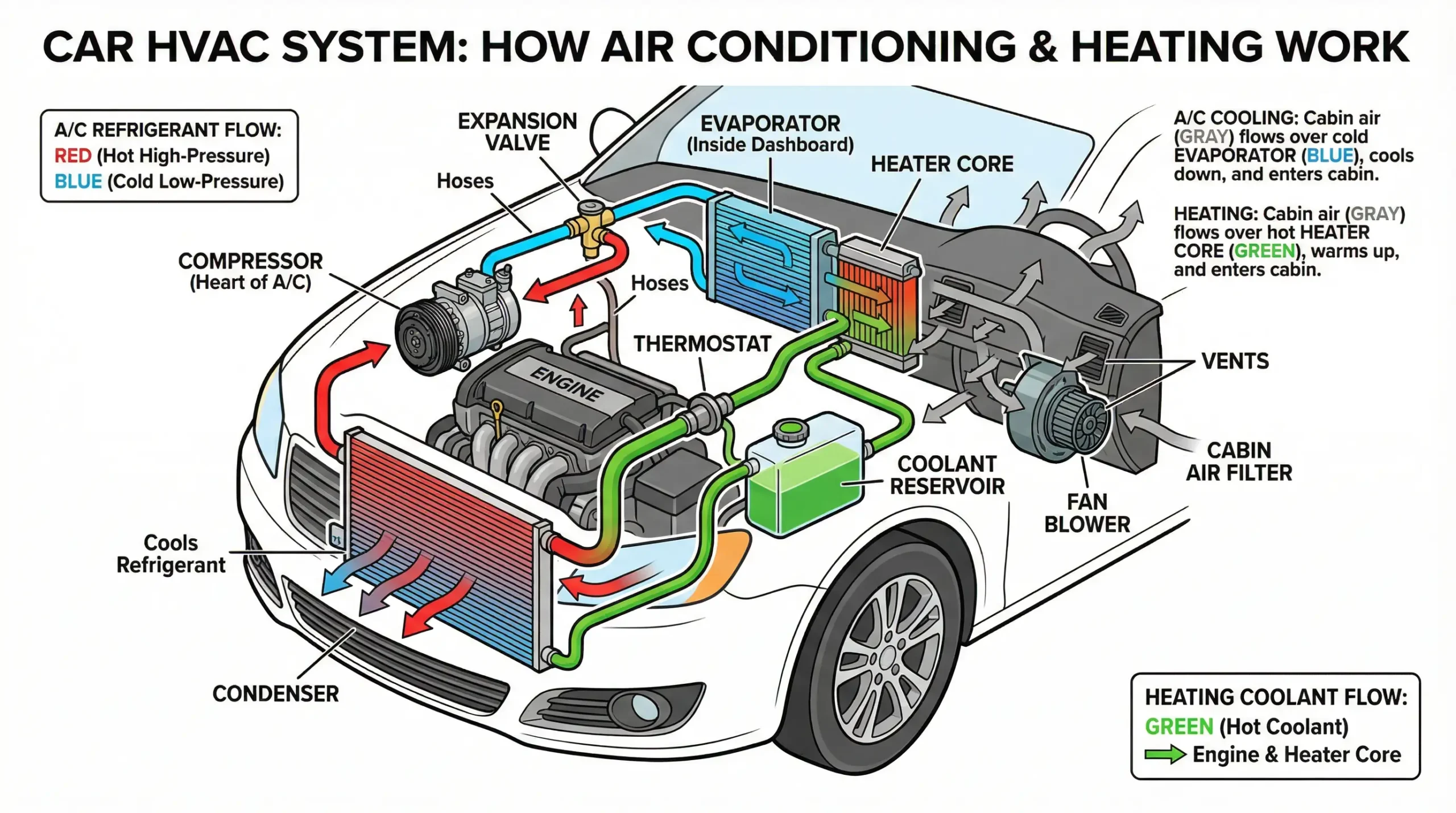
Your car’s HVAC system controls the temperature inside your car. HVAC stands for Heating, Ventilation, and Air Conditioning. It’s all connected and works together.
The Role of the Compressor and Refrigerant
Think of your compressor as the heart of your A/C system. It pumps refrigerant, a special liquid, through the system.
Here’s how it works:
- The compressor squeezes the refrigerant, making it hot and high-pressure
- This hot refrigerant goes to the condenser (that’s the part at the front of your car)
- The condenser cools it down and turns it into a liquid
- The liquid refrigerant flows to the evaporator inside your dashboard
- The evaporator makes the refrigerant cold, and a fan blower pushes air over it
- Cold air comes out of your vents
The refrigerant does double duty—it cools the air and carries oil to lubricate the compressor. If your refrigerant is low by 25%, your compressor only gets 75% of the oil it needs. This makes parts wear out faster.
How Your Heating System Uses Engine Coolant
Your heating system is clever; it uses heat that your engine already makes. Your engine gets hot when it runs. Really hot.
Coolant (some people call it antifreeze) flows through your engine to keep it from overheating. This coolant gets warm from the engine heat.
The warm coolant then flows through a small radiator inside your dashboard called the heater core. A fan blows air over the hot heater core, warming it up. That warm air comes out of your vents.
Your thermostat controls when coolant flows. If it breaks, you might get cold air from your heater even when the engine is warm.
Change Your Serpentine Belt Regularly
Your serpentine belt is a long rubber belt that connects your engine to different parts, including the A/C compressor. Without this belt, your A/C won’t work at all.
I once saw a belt snap on a hot day. The driver heard a loud pop, and suddenly the A/C stopped working. She had to drive 30 minutes in the heat to get home. The belt had cracks she never noticed.
Why the Belt Matters for Your A/C
The belt turns the compressor pulley. When the pulley spins, it runs the compressor. If the belt is loose or damaged, the compressor won’t get enough power.
A worn belt can slip on the pulley. You might hear a squealing sound when you turn on the A/C. That’s the belt struggling to grip.
Old belts can also break suddenly. Heat and age make rubber dry and brittle. Small cracks grow bigger until the belt snaps.
Recommended Replacement Schedule for Huntsville Drivers
Most car experts say change your belt every 5 years or 60,000 miles. But in Huntsville’s heat, I’d check it every year.
Look for:
- Cracks on the surface
- Shiny or glazed spots
- Fraying edges
- Missing chunks
If you see any of these signs, replace the belt right away. A new belt costs $20 to $50. A broken belt that leaves you stranded costs way more in towing and emergency repairs.
According to a study on automotive maintenance, replacing belts before they fail is one of the easiest ways to avoid breakdowns.
Replace Your Cabin Air Filter
Your cabin air filter is like a screen that catches dust, pollen, and dirt before air enters your car. Most people forget about it, but it’s super important for your A/C and heating system.
How a Clean Filter Protects Your System
A clean filter lets air flow freely through your vents. When air flows well, your A/C and heater work better and use less energy.
A dirty filter makes your fan blower work harder. The motor can overheat and burn out. Replacing a blower motor costs $200 to $400.
The filter also protects your evaporator and heater core from getting clogged. Dirt and debris can cause rot and leaks in these expensive parts.
In Huntsville, pollen is heavy in spring. I’ve pulled filters from cars that looked like they were stuffed with yellow cotton. The A/C barely worked because the air couldn’t get through.
Signs Your Cabin Air Filter Needs Changing
Check your filter if you notice:
- Weak airflow from vents, even on high fan speed
- Musty or moldy smells when you turn on the A/C
- More dust is settling on your dashboard
- Whistling sounds from the vents
Most cars need a new filter every 15,000 to 30,000 miles. In dusty or pollen-heavy areas like Huntsville, change it every 12 months.
The filter is usually behind the glove box. Some people can change it themselves in 10 minutes. It costs about $15 to $30 for a new filter.
Schedule Regular A/C Performance Checks
Your A/C system needs checkups just like you need doctor visits. Preventative maintenance catches small problems before they become big, expensive ones.
I used to skip A/C checks to save money. Then my compressor failed, and I spent $1,200 on repairs. Now I get regular checks, and my system runs great.
Understanding 134A vs. 1234YF Systems
Cars use two main types of refrigerant: 134A and 1234YF. Older cars (before 2013 or so) use 134A. Newer cars use 1234YF because it’s better for the environment.
- For 134A systems, mechanics recommend servicing every 24 months. These systems are more likely to leak because the rubber parts are older technology.
- For 1234YF systems, service them every 48 months. These systems hold pressure better, but the refrigerant costs more if you need to add some.
Check your owner’s manual to see which system you have. The type of refrigerant is usually written under the hood.
Why Refrigerant Levels Drop Over Time
Car A/C systems leak slowly. It’s normal. The rubber lines and seals let tiny amounts of refrigerant escape.
When the refrigerant is low, two bad things happen:
- Your A/C doesn’t cool as well
- Your compressor doesn’t get enough oil
Remember, refrigerant carries oil through the system. At 25% low, your compressor only gets 75% of the lubrication it needs. Parts rub together without enough oil and wear out fast.
A performance check costs $50 to $150. The mechanic will check refrigerant levels, look for leaks, and test the compressor. This small investment can save you from a $1,000+ repair bill.
Keep Your Coolant Fresh and Full
Coolant is a liquid that keeps your engine from getting too hot or too cold. It also powers your heating system. Taking care of your coolant is easy and important.
Check Coolant Levels Monthly
Pop your hood and find the coolant reservoir. It’s usually a clear plastic tank with colored liquid inside. The tank has two lines marked “MIN” and “MAX.”
The coolant level should be between these lines. If it’s below MIN, add more coolant. Make sure to use the type your car needs—check your owner’s manual.
Never open the radiator cap when the engine is hot. The coolant is under pressure and can spray out and burn you. Wait until the engine cools down.
I check my coolant when I get gas. It takes 30 seconds and helps me catch problems early.
When to Flush and Replace Your Coolant
Coolant doesn’t last forever. Over time, it becomes acidic and stops working well. Old coolant can damage your thermostat, water pump, and heater core.
Most car makers say replace coolant every 30,000 to 50,000 miles. In hot climates like Huntsville, I’d do it every 30,000 miles.
A coolant flush costs $100 to $150. The mechanic drains the old coolant, flushes the system with water, and adds fresh coolant. This simple service can prevent expensive repairs.
According to car maintenance experts, old coolant is one of the top causes of heating system failures.
Inspect Hoses and Seals for Wear
Hoses carry coolant and refrigerant through your system. Seals keep fluids from leaking out. Both wear out over time, especially in hot weather.
Common Signs of Hose Damage
Look at hoses under your hood every few months. Check for:
- Cracks in the rubber
- Soft or squishy spots
- Hard or brittle areas
- Bulges or swelling
- Wetness around connections
I once found a hose with a tiny crack. It was leaking just a few drops of coolant. If I hadn’t caught it, the hose would have burst on the highway.
Hoses near the engine get very hot. This heat makes rubber break down faster. In Huntsville’s summer heat, hoses wear out even more quickly.
Why Leaks Happen in Alabama’s Heat
Heat makes rubber expand and contract. Over months and years, this movement creates small cracks.
The heat also dries out rubber, making it brittle. A brittle hose can crack from normal engine vibration.
Seals around your compressor and other A/C parts also dry out. When they crack, refrigerant leaks out. You might notice your A/C getting weaker over time.
If you see any damage, replace the hose or seal right away. A new hose costs $20 to $80. Ignoring it can lead to overheating or a failed A/C system.
Don’t Ignore Early Warning Signs
Your car will tell you when something is wrong. You just need to listen and watch for clues.
Strange Smells and What They Mean
Different smells mean different problems:
- Sweet smell: This usually means coolant is leaking. Coolant has a sweet, syrupy smell. You might notice it inside the car or outside near the engine. A leaking heater core often causes this smell inside the car.
- Musty or moldy smell: This means mold or mildew is growing in your A/C system. It usually happens when moisture builds up in the evaporator or cabin air filter.
- Burning smell: This can mean your A/C belt is slipping or an electrical part is overheating. Don’t ignore this; it can lead to a fire.
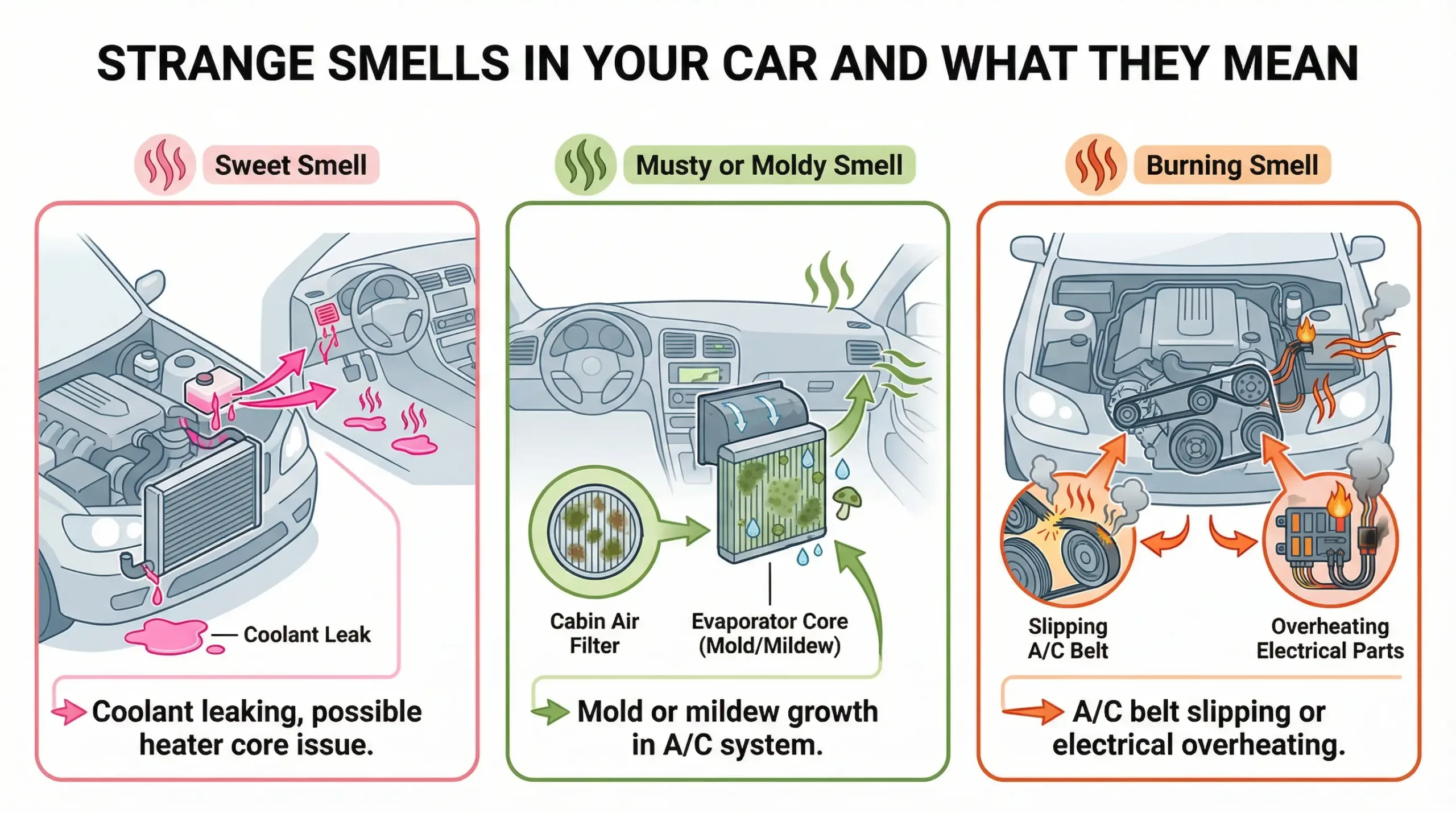
I once smelled something sweet in my car. I checked the floor mats and found they were wet. The heater core was leaking. I caught it before it damaged the carpet.
Weak Airflow and Temperature Problems
Pay attention to how your system performs:
- Weak airflow: If air barely comes out of the vents, even on high, you might have a clogged cabin air filter or a failing fan blower.
- Not cold enough: If the A/C runs but doesn’t cool well, you’re probably low on refrigerant or have a weak compressor.
- Not warm enough: If the heater runs but the air is cool, check your coolant level. You might also have a stuck thermostat or a clogged heater core.
- Warm air from A/C: This can mean you’re out of refrigerant or your compressor has failed.
Don’t wait for complete failure. If you notice any of these problems, get your system checked. Small fixes are cheaper than big repairs.
Prepare Your System for Huntsville’s Summer Heat
Summer in Huntsville is brutal on cars. Temperatures can hit 95 to 100 degrees with high humidity. Your A/C will work hard from May through September.
Pre-Summer A/C Maintenance Checklist
Before the heat arrives, do these checks in April or early May:
- Run your A/C for 10 minutes. Make sure it blows cold air.
- Check refrigerant levels. If the air isn’t ice cold, you might need more refrigerant.
- Replace your cabin air filter if it’s been more than a year.
- Inspect your serpentine belt for cracks or wear.
- Look at A/C hoses for leaks or damage.
- Clean debris from your condenser (the part at the front of your car).
I do this every spring. It gives me peace of mind knowing my A/C will work when I need it most.
Protecting Your Compressor from Overwork
Your compressor is expensive to replace—usually $500 to $1,500. Here’s how to protect it:
- Park in the shade when you can. A cooler car means the A/C doesn’t have to work as hard.
- Use a sunshade on your windshield. This keeps your car’s interior cooler.
- Crack your windows slightly when parked. This lets hot air escape and reduces the temperature inside.
- Start the A/C on low and turn it to high after a minute. This gives the compressor time to build pressure gradually.
- Run your A/C for a few minutes even in winter. This keeps seals from drying out and keeps the compressor lubricated.
These simple habits can add years to your compressor’s life.
Get Your Heating System Ready for Winter
Winter in Huntsville is usually mild, but we get cold spells. You don’t want your heater to fail when it’s 25 degrees outside.
Fall Maintenance Tips for Your Heater
Before winter hits, do these checks in October or November:
- Turn on your heater and make sure it blows warm air.
- Check your coolant level. Top it off if it’s low.
- Inspect coolant hoses for cracks or leaks.
- Test your defrost setting. It should clear fogged windows quickly.
- Make sure your cabin air filter is clean for good airflow.
Last year, I turned on my heat in late November and got cold air. The problem was simple—my coolant was low. I added some coolant, and the heater worked perfectly.
Testing Your Thermostat and Heater Core
Your thermostat controls when coolant flows through the engine. If it’s stuck open, your engine won’t warm up properly. You’ll get weak heat from your vents.
If it’s stuck closed, your engine can overheat. This is dangerous and can cause serious damage.
A mechanic can test your thermostat during an inspection. If it’s bad, replace it. A new thermostat costs $50 to $200 installed.
Your heater core is like a mini radiator inside your dashboard. If it’s clogged, you won’t get warm air. Signs of a clogged heater core include:
- Cold air from vents when the heat is on
- Sweet smell inside the car
- Foggy windows that won’t clear
- Wet floor mats
A clogged heater core usually needs professional cleaning or replacement. Don’t ignore these signs—a leaking heater core can damage your car’s interior.
Conclusion
Taking care of your car’s A/C and heating system doesn’t have to be hard. A few simple steps can save you money and keep you comfortable year-round.
Change your serpentine belt every 5 years. Replace your cabin air filter yearly. Check your coolant monthly. Get performance checks every 2 to 4 years, depending on your system.
Watch for warning signs like strange smells, weak airflow, or temperature problems. Catch issues early before they become expensive.
Huntsville’s weather is tough on cars. The summer heat and humidity put extra stress on your A/C. Winter cold can affect your heating system. But with regular care, your system will last longer and work better.
I’ve learned from my mistakes. I’ve paid for expensive repairs that simple maintenance could have prevented. Now I follow these tips, and my A/C and heater run great.
You can do this. Take 10 minutes each month to check your system. Spend a little on maintenance now to avoid big repair bills later. Your car and your wallet will thank you.
Need Professional Help with Your Car’s A/C or Heating System?
If you’re experiencing any issues with your vehicle’s heating or cooling system, or if you’d like a professional inspection before the season changes, the expert team at Brian’s Tire and Service is here to help. We offer comprehensive A/C and heating services to keep your car comfortable year-round. Contact us to learn more about how we can help extend the life of your vehicle’s HVAC system.
FAQs
How often should I service my car’s A/C in Huntsville?
For 134A systems (older cars), get service every 24 months. For 1234YF systems (newer cars), service every 48 months. Huntsville’s hot, humid climate can cause faster refrigerant loss, so some mechanics recommend checking it yearly.
What’s the difference between 134A and 1234YF refrigerant systems?
134A is the older refrigerant used in cars before 2013 or so. It leaks more easily and costs less. 1234YF is newer and better for the environment. It holds pressure better but costs more to refill. Check under your hood or in your owner’s manual to see which type you have.
Can I check my coolant level myself?
Yes! Find the coolant reservoir under your hood—it’s a clear plastic tank. Make sure the engine is cool, then check that the liquid level is between the MIN and MAX lines. If it’s low, add the correct type of coolant for your car. Never open the radiator cap when the engine is hot.
Why does my car’s A/C smell bad when I turn it on?
A bad smell usually means mold or mildew is growing in your A/C system. Moisture builds up in the evaporator or on a dirty cabin air filter. Replace the filter and have a mechanic clean your A/C system. Running the A/C on high with no recirculation for a few minutes can also help dry it out.
How long should my car’s A/C compressor last?
A well-maintained compressor can last 8 to 10 years or more. Keep refrigerant levels topped off so the compressor gets proper lubrication. Change your serpentine belt on time. Avoid overworking the system by parking in the shade when possible. Regular maintenance is the key to a long compressor life.