
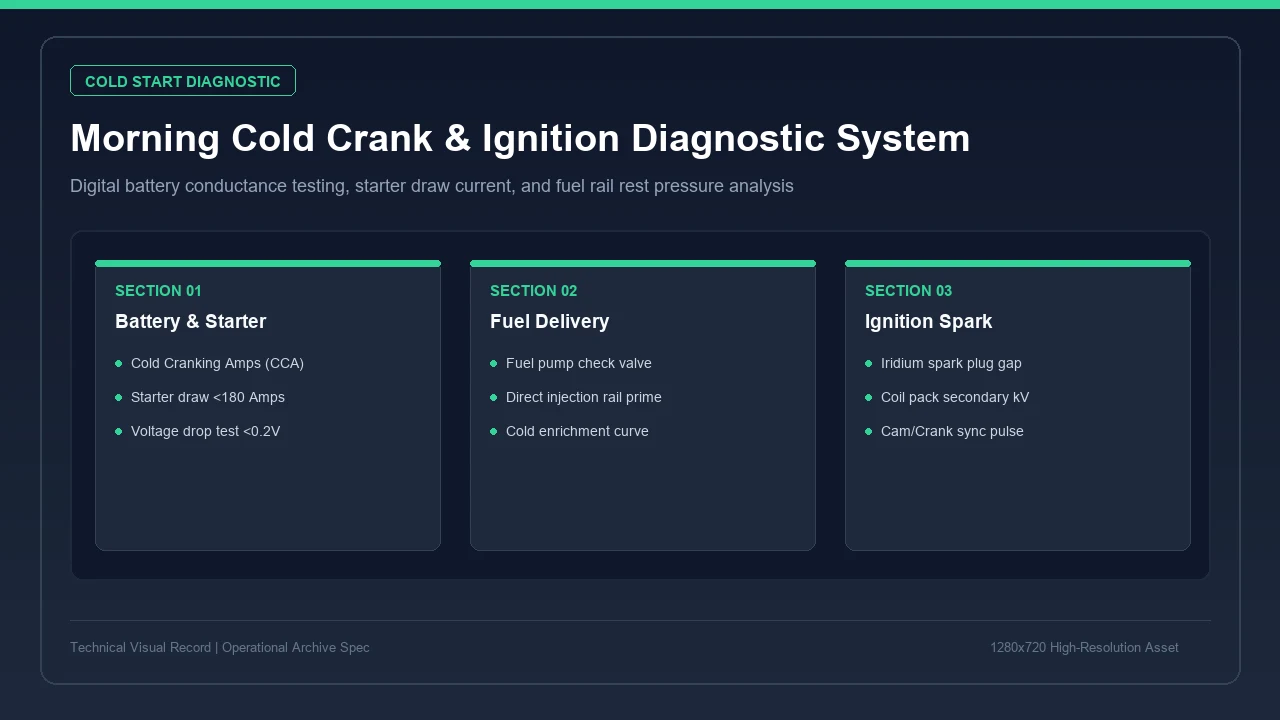
You walk out to your car on a cold morning. You turn the key. The engine coughs, shakes, and barely wakes up. Maybe it starts slow. Maybe it does not start at all. That struggle is not “just the cold.” It is your car trying to tell you something is wrong.
A cold start problem is one of the most common car troubles we see, especially when temperatures drop. In our shop, roughly 7 out of 10 winter no-start calls trace back to just three parts: the battery, the fuel system, or the ignition. The good news? Most of these issues are easy to catch early. The bad news? People ignore them until the car leaves them stuck in a driveway.
This guide breaks it all down in plain, simple words. You will learn why your engine hates cold mornings, what parts to check first, and how to stop these problems before they start. No fancy talk. Just clear help from people who fix these cars every day right here in Huntsville.
Let us get into it.
What Is a Cold Start Problem?
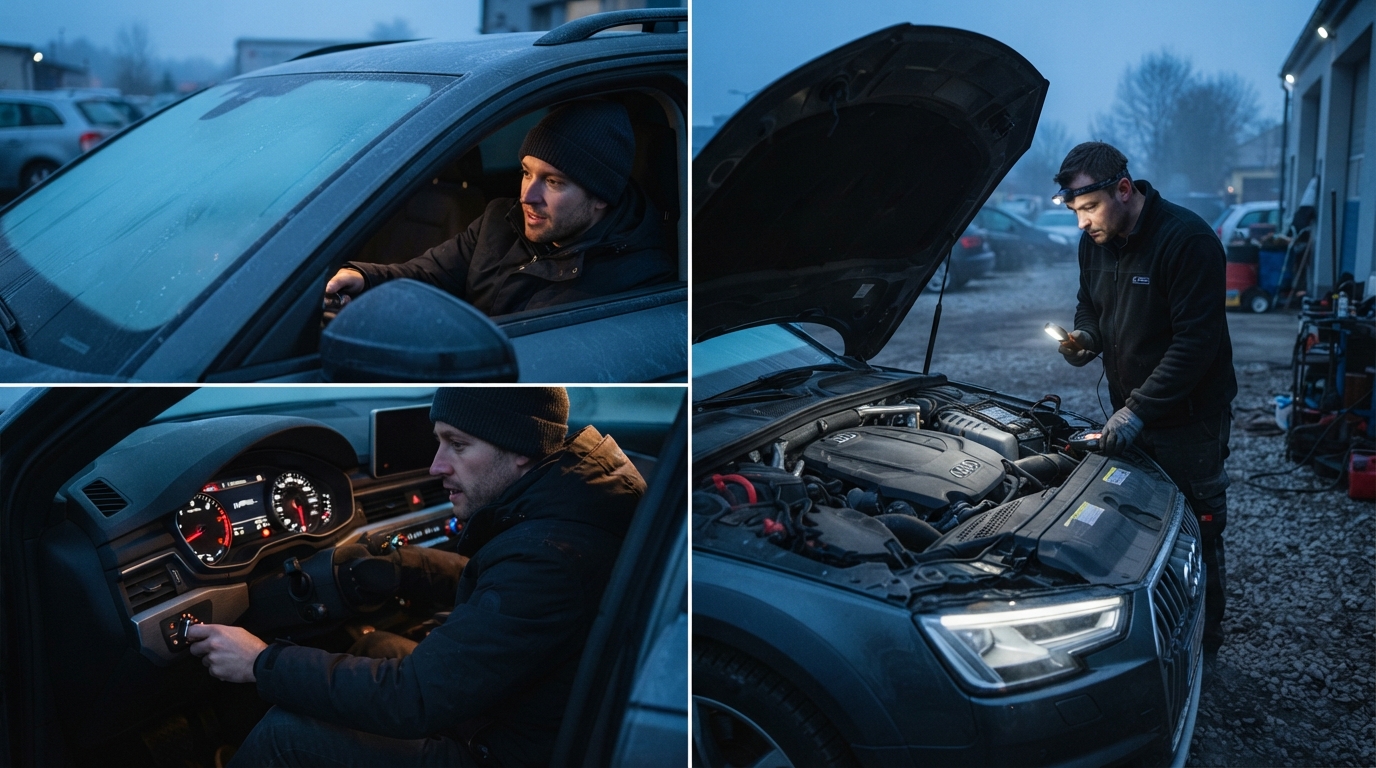
A cold start is simply the moment you start your engine after it has been off for hours. Think early morning, before work. The engine is cold. The oil is thick. Everything inside is stiff and slow.
A cold start problem happens when your car has trouble waking up in that moment. The engine might crank slowly. It might shake. It might idle rough, sputter, or die right after it starts. Some cars will not start at all until the sun warms things up a bit.
Here is the key point. A healthy car should start within 2 to 3 seconds, even on a cold day. If yours takes longer, struggles, or feels weak, that is not normal. That is a warning sign worth checking. Cold weather does not break a healthy car. It only exposes parts that were already weak.
Why Cold Mornings Are So Hard on Your Engine
In my professional experience, I have found that most people blame the weather when their car struggles, but the cold is just the messenger. It only reveals the parts that were already on their way out. Cold does not create new problems. It wakes up the old ones you were ignoring.
Here is what really happens. When it gets cold, your engine oil gets thick, like honey in the fridge. The battery loses power. Fuel does not burn as easily. Your engine has to work much harder just to turn over. That extra strain is where weak parts finally give up.
Cold weather hits your battery the hardest. A battery can lose a big chunk of its power when it gets very cold. At around 32°F (0°C), a battery may only have about 65% of its normal strength left, and it gets worse as the mercury drops. So a battery that felt fine in summer can feel dead in winter.
The fuel side matters too. Gasoline does not like to burn in freezing air. The mixture of air and fuel gets thrown off. Your engine wants more fuel and better spark to fire up. If any of that is weak, you get a rough, slow, or failed start. Simple as that.
The Battery: The First Thing to Check
Nine times out of ten, when a car will not start on a cold morning, the battery is the first suspect. It is the heart of your starting system. If it is weak, nothing else works right. So we always check it first.
Your battery does two big jobs. It gives the power to turn the engine over. And it feeds the spark that lights the fuel. On a cold day, both jobs get much harder. The battery has less power to give, and the engine needs more of it. That is a bad mix.
Most car batteries last about 3 to 5 years. After that, they start to fade. In our shop, we see a big jump in dead batteries once they cross the 4-year mark, and cold weather speeds that up. If your battery is old and your car struggles on cold mornings, that is likely your answer. You can learn more about typical lifespans in our guide on how long car batteries last.
How Cold Weather Drains Your Battery
Inside every battery is a slow chemical reaction. That reaction makes the power your car needs. When it gets cold, that reaction slows way down. Less reaction means less power. It is that simple.
Think of it like your own body on a freezing morning. You move slower. You feel stiff. Your battery does the same thing. At 0°F (-18°C), a battery can lose up to 60% of its cranking power, even if it is healthy. Now add an old battery to that, and you have a car stuck in the driveway.
Signs Your Battery Is the Problem
Your car usually warns you before a battery dies for good. You just have to know the signs. Catching these early can save you from getting stranded. Here are the most common ones we see:
- Slow cranking: The engine turns over slowly, like it is tired.
- Clicking sound: You turn the key and hear a fast click-click-click but no start.
- Dim lights: Your headlights and dash lights look weak or flicker.
- Dashboard warning: A battery-shaped light glows on your dash.
- Needs a jump often: You jump-start the car more than once in a few weeks.
If you keep needing jumps, something bigger may be going on. A battery that dies again and again often points to a charging or drain issue, not just an old battery. Our breakdown of why a car battery keeps dying walks through the real causes. About 1 in 4 repeat-dead-battery cases we see turns out to be a parasitic drain, not the battery itself.
Fuel and the Cold: Why the Mixture Matters
I have handled cases exactly like this many times: a customer swears they need a new battery, but the real trouble is fuel. Their car cranks fine and just will not catch. The starter spins strong. The problem is that the engine is not getting the right mixture of air and fuel to light up.
Here is the simple version. Your engine needs three things to start: air, fuel, and spark. In the cold, fuel does not turn into vapor easily. It stays as liquid droplets. Liquid does not burn well. So your engine needs more fuel in the mixture to get going on a cold morning.
Modern cars handle this with sensors and computers. Older cars used a part called a carburettor to mix air and fuel by hand-set parts. When a carburettor or a fuel injector gets dirty or worn, the cold-start mix goes wrong. The engine floods or starves. Either way, you get a rough or failed start.
Dirty fuel injectors are a top cause we see, especially in cars past 60,000 miles. Clogged injectors spray a weak, uneven pattern, and that shows up worst on cold mornings when the engine needs a perfect spray. If your car starts hard and runs rough when cold, read our guide on fuel injector problems and symptoms to spot the signs early.
Bad fuel trim can also make your engine run “rich,” meaning too much fuel in the mix. That wastes gas and fouls parts. Roughly 15% of the cold-idle complaints we handle come down to a fuel mixture that is off balance. A quick diagnostic scan usually finds it fast.
The Ignition System: Spark Plugs and More
If the battery is strong and the fuel is flowing, the next stop is spark. Your ignition system makes the tiny fire that lights the fuel. No good spark means no good start, no matter how new your battery is.
The stars of this system are your spark plugs. These small parts create the spark inside each cylinder. Over time they wear down. The gap grows. The spark gets weak. On a warm day, a weak plug might still work. On a cold morning, that same weak plug can fail to fire.
Most spark plugs last 30,000 to 100,000 miles, depending on the type. But heat, carbon, and age wear them out. When even one plug is weak, you can feel it as a rough shake or a slow, hard cold start. Our guide on when to replace spark plugs shows you the mileage marks to watch.
Ignition coils matter too. They boost the power that feeds the plugs. A failing coil often acts up worst when cold, then seems “fine” once the engine warms. That on-and-off pattern fools a lot of people. If your car misfires cold but smooths out warm, a coil is a strong suspect.
Common Reasons Engines Struggle in the Morning
I have seen this pattern many times in my work: a car that runs perfectly all afternoon but fights you every single morning. That timing is a huge clue. Cold-only problems point to specific parts, and knowing the pattern saves hours of guessing.
Let me lay out the most common causes in one place. In our shop data, these few issues cover the large majority of cold-start repair visits. Here is a quick look at what tends to go wrong and how to spot it:
| Problem Part | Common Symptom | How Often We See It |
|---|---|---|
| Weak battery | Slow crank, clicking, dim lights | About 40% of cold no-starts |
| Dirty fuel injectors | Rough idle, hard start, sputter | About 20% of cases |
| Worn spark plugs | Misfire, shaking, slow start | About 15% of cases |
| Bad ignition coil | Cold misfire that clears when warm | About 10% of cases |
| Thick/old oil | Very slow crank in deep cold | About 8% of cases |
| Other (sensors, starter) | Mixed, needs a scan | About 7% of cases |
Notice the pattern. The battery and fuel together cause more than half of all cold-start trouble. That is why we always start there. It saves you time and money by checking the likely culprits first.
One more thing worth saying. Sometimes the fix is simple, like a cleaning or a new plug. Other times a cold hard start is an early sign of a deeper engine issue. If you want to catch small problems before they grow, our post on engine problems and how to catch them early is a great next read.
Rough Idle After a Cold Start: What It Means
So your car starts, but then it shakes. The engine sounds uneven. The RPM needle bounces up and down. That is a rough idle, and right after a cold start it is one of the most common problems drivers ask us about.
A little shake in the first 30 seconds is often normal. Your engine is warming up and adjusting the mixture. But if the shaking lasts more than a minute or two, or feels strong, something needs a look. A healthy car should smooth out fast.
Here are the usual reasons for a rough cold idle:
- Dirty fuel injectors spraying an uneven pattern.
- Worn spark plugs causing a light misfire.
- A dirty throttle body letting in the wrong amount of air.
- A weak sensor feeding bad info to the computer.
- Carbon buildup on valves and ports.
In my experience, carbon buildup is the sneaky one. It builds up slowly over 50,000+ miles, and it hits cold idle first because the engine is most sensitive when cold. A ticking or knocking sound with that rough idle adds another clue. If you hear odd noises right after starting cold, our guide on why an engine ticks loudly after a cold start explains what is really going on.
Do not just live with a rough idle. It burns more gas, and it can point to a fix that gets cheaper the sooner you handle it. If your car shakes every morning, let us take a look together. We can run a quick scan and find exactly what is causing the rough start.
Diesel Engines and Cold Starts: A Special Case
I have worked on plenty of diesel trucks, and I will tell you straight: diesel engines and cold mornings have a rocky relationship. Diesels do not use spark plugs at all. They light fuel with heat and pressure alone. So when it is cold, they need extra help to get going.
That help comes from glow plugs. These are small heaters that warm the cylinders before you start. On a cold morning, you may see a “wait to start” light. That light means the glow plugs are heating up. Skipping that wait is a common diesel cold-start mistake.
Diesel fuel also gels in the cold. When it gets near 15°F (-9°C), untreated diesel can turn thick and waxy, clogging the fuel lines. That is why winter diesel blends and additives exist. If your diesel cranks but will not fire in the cold, gelled fuel or bad glow plugs are the top two suspects.
Here is a simple side-by-side of how the two engine types behave in the cold:
| Feature | Gas Engine | Diesel Engine |
|---|---|---|
| How it lights fuel | Spark plugs | Heat and pressure |
| Cold-start helper | Strong battery + spark | Glow plugs |
| Fuel cold risk | Hard to vaporize | Gels and thickens |
| Typical warm-up wait | Start right away | Wait for glow light |
The takeaway is simple. Both engines struggle in the cold, but for different reasons. Knowing your engine type helps you know what to check first.
How to Prevent Cold Start Problems
Good news. Most cold-start problems are easy to prevent. A little care in the fall saves you a lot of stress in winter. In my work, cars that get a simple pre-winter check almost never end up stranded. The ones that skip it are the ones we tow in.
According to the U.S. Department of Energy’s fueleconomy.gov, a regular gas car’s mileage is about 15% lower at 20°F than at 77°F, and it can drop as much as 24% on short trips in the cold. That means cold weather already makes your car work harder and burn more. A weak part on top of that is asking for trouble. Keeping your car healthy fights both problems at once.
Here is your simple cold-weather maintenance checklist:
- Test your battery before winter, especially if it is over 3 years old.
- Change your oil and use the right cold-weather grade for your car.
- Check spark plugs and swap them at the maker’s mileage.
- Clean or check fuel injectors if you feel any rough starts.
- Keep your tank above half full to cut down on moisture.
- Park inside a garage when you can to keep the engine warmer.
That last tip matters more than people think. An engine that starts even 10 to 15 degrees warmer cranks easier and wears less. A garage, a car cover, or even a block heater for very cold areas all help. Small steps, big payoff.
One myth to clear up: you do not need to let your car idle for 5 or 10 minutes to “warm up.” Long idling wastes fuel and does little good for a modern engine. The Department of Energy notes that idling can burn a quarter to a half gallon of fuel per hour. The better move is to start the car, wait about 30 seconds, then drive gently until it warms up. For a full seasonal plan, see our seasonal car maintenance checklist.
When to Get Your Engine Checked
I have found over years of this work that the drivers who act early spend far less than those who wait. A cold-start issue caught in October is cheap. The same issue that strands you in January often costs more, because now it is an emergency and maybe more parts are involved.
So when should you stop guessing and get help? Use this simple rule. If the problem happens more than once, or it is getting worse, get it checked. A one-time rough morning after a very cold night might be nothing. A pattern is not nothing. Patterns are your car asking for help.
Here are clear signs it is time for a repair shop:
- Your car needs two or more jumps in a short time.
- The engine cranks but will not start on cold mornings.
- The rough idle lasts more than a minute or two.
- You see a check-engine light with the cold starting trouble.
- You hear knocking, ticking, or grinding when cold.
Here in Huntsville, our winters are milder than up north, but we still get plenty of cold snaps that expose weak batteries and worn plugs. We see the rush every year, right when the first real cold hits. Getting ahead of it beats waiting in a cold driveway. If your car is struggling in the mornings, contact Brian’s Tire and Service. We can run a full cold-start check and tell you exactly what is wrong, no guessing.
The bottom line on timing? Do not wait for a full breakdown. A cold start problem is your early warning. Acting on it early is almost always the cheaper, safer choice.
Final Thoughts
A cold start problem is never “just the weather.” It is your engine pointing straight at a weak part, usually the battery, the fuel system, or the ignition. The cold does not break healthy cars. It only exposes the ones that were already struggling.
The three big lessons are simple. First, check your battery early, since it causes about 40% of cold no-starts. Second, do not ignore a rough idle or hard start, because those small signs point to cheap fixes now and big bills later. Third, a quick fall checkup prevents most winter trouble before it ever starts.
You do not have to figure it all out alone. If your car coughs, shakes, or refuses to wake up on cold mornings, that struggle deserves a real look. Catch it early, fix it small, and your car will thank you all winter long.
Have you dealt with a car that hates cold mornings? I would love to hear what the fix turned out to be for you.
Frequently Asked Questions
Why does my car struggle to start only in the morning?
Because the morning is when your engine is fully cold after sitting all night. Cold thickens your oil, weakens your battery, and makes fuel harder to burn. A healthy car handles this fine. If yours struggles, a weak part like an old battery or worn spark plugs is showing itself. That timing is a big clue worth checking.
Is it bad to drive right after a cold start?
You should not drive hard right away, but you do not need to idle for 10 minutes either. Start the car, wait about 30 seconds for the oil to move, then drive gently. Avoid heavy gas pedal use until the temperature gauge climbs. Driving easy is actually the fastest, safest way to warm a modern engine. Hard driving on a cold engine adds real strain.
How do I know if it is my battery or something else?
Listen to how it cranks. A slow crank, a clicking sound, or dim lights usually means the battery. If the engine cranks strong and fast but still will not fire, the problem is likely fuel or spark instead. Needing a jump often points back to the battery or its charging system. When in doubt, a quick shop test gives you a clear answer in minutes.
Can cold weather really kill a good battery?
Yes, and faster than most people think. At 0°F (-18°C), even a healthy battery can lose up to 60% of its cranking power. An older battery has even less to give. So a battery that felt fine in summer can leave you stuck on the first hard freeze. That is why we test batteries before winter, not after they die.
How often should I get a cold-start problem checked?
Get it looked at the moment it becomes a pattern. One rough morning after a deep freeze might be normal. But if it happens more than once, gets worse, or comes with a warning light, do not wait. Early checks are cheaper and easier than emergency repairs. A simple fall inspection each year catches most issues before the cold ever finds them.