
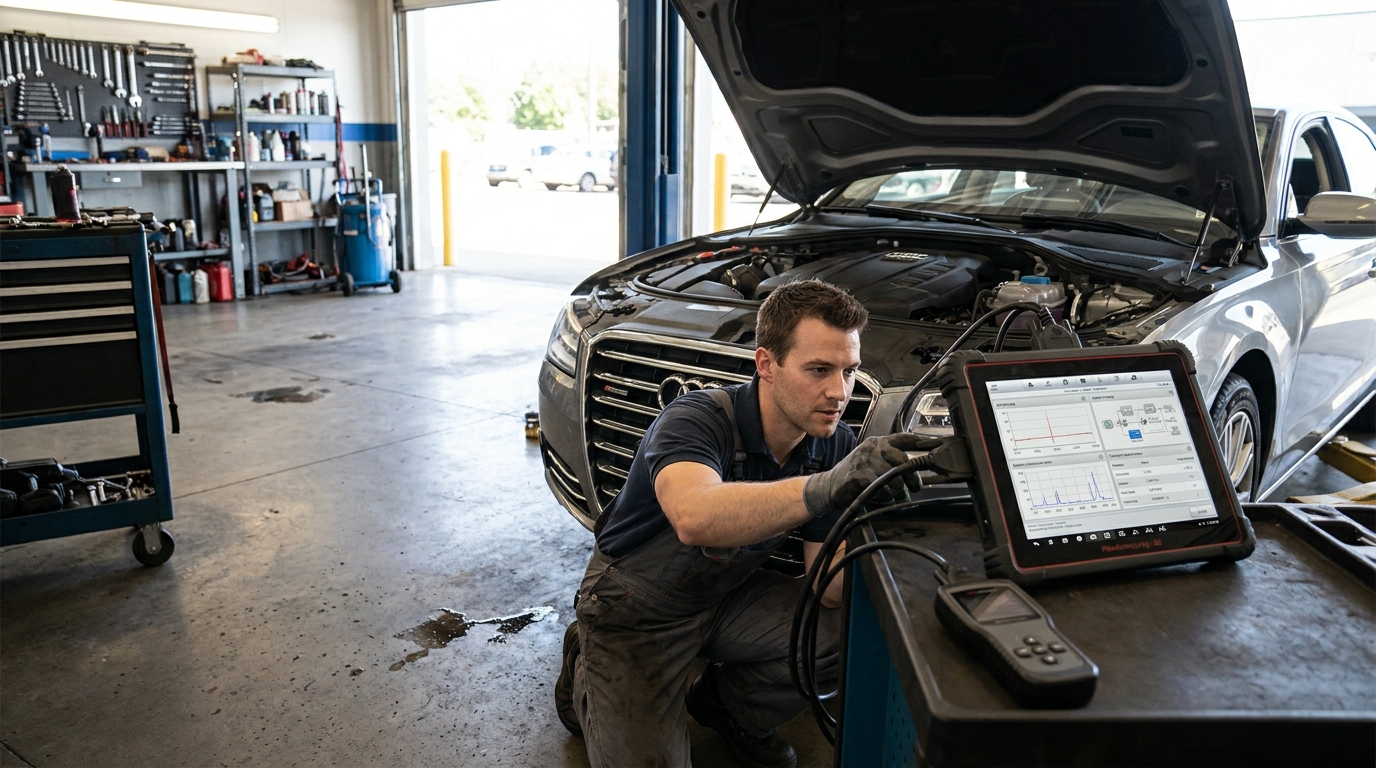
Your check engine light pops on. You drive to the parts store, they scan your car for free, and hand you a code like P0301. Feels like an answer, right? Here is the hard truth from the shop floor: that code is a clue, not a diagnosis. A cheap reader tells you where to look. It almost never tells you why the problem is happening.
What an OBD-II Code Reader Really Does
An OBD-II code reader is a small device that plugs into a port under your dash. Every car and light truck sold in the United States since 1996 has this same 16-pin port. You connect the reader, it talks to your car’s computer, and it pulls out a diagnostic trouble code. That is its whole job. It reads the code and, on nicer models, clears it.
Think of the reader like a smoke alarm. The alarm beeps and tells you there is smoke somewhere. It does not tell you if you burned toast or if the house is on fire. Roughly 9 out of 10 drivers I meet think the code names the broken part. It does not. It names the system that reported trouble, and that gap causes most wasted money in car repair.
Basic readers max out fast. They show you stored codes and maybe a pending code or two. Many cannot show live data, and almost none can run a test on a part. A $25 reader and a $5,000 professional scan tool both plug into the same port, but what they can do after that is night and day. One reads. The other investigates.
Here is a simple way to picture the limit. The reader sees the final report from your car’s brain. It cannot ask follow-up questions. It cannot watch the engine work. It cannot command a part to move and see if it responds. For a loose gas cap, that is fine. For a rough-running engine, it leaves you guessing.
Code Reader vs Professional Scan Tool: The Big Difference
In my professional experience, I have watched this exact scene play out hundreds of times. A customer comes in holding a slip of paper with a code, sure they need one specific part. In about 7 of 10 of those cases, the part they name is not the real cause. The code was honest. The cheap tool just could not finish the story.
A professional scan tool does far more than read codes. It reads live data from dozens of sensors at once. It can command parts to turn on and off. It talks to every computer in the car, not just the engine. It pulls factory repair steps. It can even record a fault while you drive so we can play it back later. That is a different class of machine.
The price gap is real, and so is the skill gap. The tool is only half the value. The person reading the numbers is the other half. A great tech with a mid-tool beats a rookie with the fanciest scanner 10 times out of 10. Below is a plain look at how the two compare.
| Feature | Basic OBD-II Reader | Professional Scan Tool |
|---|---|---|
| Reads trouble codes | Yes | Yes |
| Shows live sensor data | Rarely | Yes, dozens at once |
| Bi-directional control (commands parts) | No | Yes |
| Reads ABS, airbag, transmission | No | Yes |
| Factory repair data | No | Yes |
| Records a fault while driving | No | Yes |
| Typical price | $25–$100 | $2,000–$5,000+ |
If your car is acting up and the code has you confused, the team at Brian’s Tire and Service here in Huntsville can run a full scan and show you what the numbers really mean. No guessing, no upsell, just a clear picture of your engine’s health.
A Trouble Code Is a Clue, Not an Answer
Let me break down what a code really is. A diagnostic trouble code is your car’s way of saying “one of my readings went outside the normal range.” That is it. The code P0171, for example, means the engine is running “too lean”, too much air, not enough fuel. It does not tell you what caused the lean condition.
That single lean code has at least a dozen possible causes. A vacuum leak. A weak fuel pump. A dirty mass air flow sensor. A bad oxygen sensor. A leaking fuel injector. Studies of repair patterns show one code can point to 10 or more different faults. If you just buy the part that shares the code’s name, your odds of fixing it on the first try are low.
This is why I never trust a code alone. The code opens the case. The real work is reading live data, checking fuel trim numbers, and testing parts one by one. A good tech treats the code like a detective treats a footprint. It narrows the search. It does not name the suspect. If you want to understand why the light behaves the way it does, our guide on the check engine light staying on while the car runs fine walks through it in plain words.
Two cars can show the very same code for two totally different reasons. I have seen a P0300 random misfire come from worn spark plugs on one car and a cracked intake on the next. Same code. Different fix. The tool that tells them apart is not the reader, it is the live data and the trained eye reading it.
The “Parts Cannon” Trap That Drains Your Wallet
I have handled cases exactly like this more times than I can count. A driver reads a code, buys the matching part, installs it, and the light comes right back. So they buy another part. Then another. In the trade we call this the “parts cannon”, firing parts at the car and hoping one sticks. It is the fastest way to burn cash on a car.
Run the math and it stings. Say a lean code sends you chasing parts. An oxygen sensor might run $150, a mass air flow sensor near $200, and a fuel pump can top $500. Guess wrong twice and you have spent $350 before the real $40 vacuum hose ever gets touched. Bad guessing can easily cost 3 to 4 times more than a proper diagnosis up front.
The sad part is the fix is often cheap once you find it. The money bleeds out during the search, not the repair. A proper diagnostic costs a set fee and ends the guessing. Here is how the two paths tend to stack up in real dollars.
| Approach | What Happens | Typical Total Cost |
|---|---|---|
| Parts cannon (guessing) | Buy 2–3 wrong parts, keep trying | $300–$700+ |
| Professional diagnosis | Pinpoint the real cause first | $100–$150 + the actual fix |
There is a second cost people forget. Time. Every wrong part means another weekend under the hood or another trip to the shop. If your car keeps throwing the same code, catching the true cause early saves both money and headaches, our piece on spotting engine problems before they grow shows the warning signs worth watching. And if a bad fuel injector is the culprit, the symptoms in our fuel injector problem guide line up closely with lean and misfire codes.
Live Data: Watching Your Engine Think
Here is where a real scan tool starts to shine. Live data is a stream of real-time numbers coming straight from your engine while it runs. Engine speed. Coolant temperature. Fuel trim. Sensor voltages. A pro tool can show 50 to 100 of these values at once, updating many times per second. A basic reader shows none of this.
Why does that matter so much? Because a broken part often has no stored code at all. A weak oxygen sensor might still work, just slowly and lazily. It passes the pass-fail check, so no code sets. But watch its voltage swing on live data and a trained tech spots the sluggish pattern in seconds. The code was silent. The data was not.
I lean on live data every single day. A healthy oxygen sensor should swing up and down many times in 10 seconds. A tired one crawls. Fuel trim that sits above +10% whispers “vacuum leak” long before a code ever fires. These are the tells that separate a real diagnosis from a lucky guess, and no free parts-store scan will show them to you.
Live data also proves a repair worked. After a fix, I watch the same numbers settle back into range before I hand the keys over. That final check is why our repairs tend to stick. If your car loses power or stumbles under load, live data usually finds it fast, the causes we cover in why a car loses power while driving almost always show up in the data stream first.
Freeze Frame: The Snapshot Most Drivers Miss
In my work I have found that freeze frame data is one of the most skipped tools in the whole diagnosis, even though it is built right into the system. When your car sets a code, it also snaps a photo of the exact conditions at that moment. Engine speed, load, temperature, and more — all frozen in time. A basic reader usually cannot show it. A pro tool always can.
Freeze frame answers the question “what was happening when it broke?” Say a misfire code sets. The freeze frame shows it happened at 2,000 RPM, cold engine, light load. That tiny clue points me toward a cold-start issue, maybe a spark or fuel problem that only shows up before the engine warms. Without that snapshot, I am guessing across the whole map.
This one feature saves hours. Roughly 60% of hard-to-find faults get easier the moment I read the freeze frame, because it tells me exactly when to try and copy the problem. A fault I can copy is a fault I can fix. A fault I cannot copy is a fault that comes back. Freeze frame turns a random gremlin into a repeatable test.
Bi-Directional Control: When the Tool Talks Back
Most people picture a scanner as a device that only listens to the car. A professional scan tool does the opposite too. It talks back. This is called bi-directional control, and it is one of the biggest reasons a real tool wins. It lets a tech command parts directly, without ripping anything apart first.
Picture a fan that will not turn on. With bi-directional control, I press a button and command the cooling fan to run. If it spins, the fan and wiring are fine, so the trouble is in the sensor or control side. If it stays dead, I just proved the fan or its circuit is bad. That single test can replace 30 minutes of tearing into wiring harnesses.
I use these active tests constantly. I can cycle fuel injectors one at a time to find a dead one. I can command the EGR valve open. I can bleed ABS brakes electronically. Each test gives a clean yes-or-no answer instead of a guess. That is the difference between “I think it is the fan” and “I know it is the fan.” A code reader can do none of this.

There is real safety value here too. Bleeding certain brake systems or resetting an electronic parking brake requires bi-directional control. Skip the tool and you can lock up a system or leave air in the lines. Some of these jobs simply cannot be done right without the tool talking to the car. For anything wiring-related, the patterns in our car electrical issues guide show why command testing beats poking around blindly.
One Tool, Every Module: What a Pro Actually Sees
I have seen this pattern many times in my work: a customer’s real problem was never in the engine at all. Their check engine light was off, but the car drove strange. A basic reader saw nothing because it only speaks to the engine computer. Your modern car has 10 to 40 separate computers, and most cheap readers ignore all but one.
These computers are called modules. There is one for the engine, one for the transmission, one for the brakes (ABS), one for the airbags, one for the body, and many more. They all chat over a shared network called the CAN bus. A fault in the transmission module or ABS module will not show up on an engine-only reader. It hides in plain sight.
A professional scan tool reads them all. It runs a full-system scan and lists every code from every module in one sweep. According to the California Air Resources Board, the OBD system “monitors virtually every component that can affect the emission performance of the vehicle” and stores that data so a technician can “accurately find and fix the problem” (CARB On-Board Diagnostics Program). The system is built for a technician with a real tool — not a bare code reader.
Here is a look at the modules a full scan reaches that a basic reader usually cannot:
| Module | What It Controls | Seen by Basic Reader? |
|---|---|---|
| Engine (ECM/PCM) | Fuel, spark, emissions | Yes |
| Transmission (TCM) | Shifting, gear logic | Rarely |
| ABS | Anti-lock brakes, traction | No |
| Airbag (SRS) | Crash safety systems | No |
| Body (BCM) | Lights, locks, windows | No |
| Climate / HVAC | Heat and A/C control | No |
When a warning light other than the engine light is on — ABS, airbag, traction — a basic reader is blind to it. That is not a knock on the reader. It was built for one job. It just is not the job most drivers think it is doing.
“But My Car Runs Fine” — The Check Engine Light Myth
One of the most common things I hear is “the light is on, but it runs fine, so I ignored it.” I get the logic. The problem is that modern cars are built to hide trouble from you. The U.S. Department of Energy’s fuel economy site puts it plainly: modern vehicles are “so advanced that they may seem to drive normally even when a repair is needed” (fueleconomy.gov).
That good behavior is a trap. The same source notes the cause could be minor, like a loose gas cap, or serious enough to “reduce your fuel economy, increase emissions, and lead to costly repairs later.” A steady light means a fault is stored right now. A flashing light means an active misfire that can wreck your catalytic converter in minutes — and that part can cost over $1,000 to replace.
So “runs fine” is not the same as “is fine.” A small misfire you cannot feel still dumps raw fuel and slowly cooks expensive parts. Ignoring a light for weeks can turn a $100 repair into a four-figure one. The car feels okay right up until the day it very much does not. A quick scan tells you which camp you are in.
Here is my honest rule of thumb. If the light is steady and the car drives normal, you have time — but do not wait months. If the light is flashing, stop driving and get it checked that day. Not sure which you are dealing with? The team at Brian’s Tire and Service can read the codes and the live data and tell you if it is a “drive it in this week” or a “tow it in now” situation.
When a Cheap Code Reader Is Enough (and When It Is Not)
Let me be fair to the little $30 reader. It is not useless. For simple, clear jobs, it does exactly what you need, and I keep a basic one in my own glove box. If you just replaced a battery and want to clear an old code, or you want to check a gas cap warning, a reader is perfect. No shop visit needed.
The reader earns its keep in a few real cases. It confirms a light is really on. It reads a code so you can look it up. On some cars it resets a light after a known fix. About 20% of check engine lights truly are simple — a loose cap, a cleared fluke — and a reader handles those fine. The trouble starts when the fix is not obvious.
Here is a simple guide for when each tool fits:
- A code reader is enough when: the light just came on after a battery swap, you suspect a loose gas cap, or you only want to know the code before calling a shop.
- You need a professional scan when: the car runs rough, the code keeps coming back, more than one light is on, the transmission or ABS acts up, or the same part was already replaced and did not fix it.
- Skip the guessing entirely when: the light is flashing, you smell fuel, or the car loses power, these need real diagnosis fast.
The mistake is not owning a reader. The mistake is expecting a reader to do a scan tool’s job. It is like using a bathroom scale to diagnose a stomachache. The scale gives you a real number. That number just does not answer the question you actually have.
What Our Professional Diagnostic Actually Includes
A real diagnostic is a process, not a plug-in. When you bring a car to us, the scan tool is step one, not the whole show. The U.S. EPA runs its National Vehicle and Fuel Emissions Laboratory to a strict, ISO-accredited testing standard (EPA Vehicle and Fuel Emissions Testing), real diagnosis follows that same idea of measure, verify, and confirm rather than assume.
Our process is straightforward. First, a full-system scan pulls codes from every module. Then we read freeze frame and live data to see the conditions and the sensor behavior. Next come targeted tests, bi-directional commands, sometimes a compression or pressure check. Only then do we name a cause. That order matters. It is why our first-fix success rate stays high, around 9 in 10 jobs.
We also verify the fix before you leave. We clear the codes, drive the car, and watch the live data settle back to normal. If a deeper mechanical issue shows up, like low compression, we go further, our engine compression test explained guide covers what those readings mean. And if the car is simply due for maintenance, our breakdown of what an engine tune-up actually includes shows the parts that keep small codes from ever setting.
The goal is simple. We want you to leave knowing what was wrong, why it happened, and that it is truly fixed. No parts cannon. No “let’s try this and see.” Just a clear answer backed by real data. That is the whole difference between reading a code and diagnosing a car.
Final Thoughts
A code reader and a professional scan tool both plug into the same port, but they are not the same thing at all. One reads a clue. The other solves the case. The reader tells you a system reported trouble. The scan tool, in trained hands, tells you exactly which part failed and why.
If you only take one idea from this, make it this: a trouble code is the start of the story, not the end. Chasing parts based on a code alone is how good money goes bad. Reading live data, freeze frame, and running real tests is how the problem actually gets fixed the first time.
Your car talks all the time. It sends out sensor readings, module reports, and warning signs every second it runs. A cheap reader hears one word of that conversation. A real diagnosis listens to the whole thing. When your light comes on next, you now know which tool the job really needs, and why the difference is worth it.
Have you been burned by the parts cannon, or fixed something yourself with a basic reader? I would love to hear how it went. And if your check engine light is on right now and you are not sure what it means, bring it by Brian’s Tire and Service in Huntsville, we will read the real story your engine is telling.
Frequently Asked Questions
Can a free parts, store scan fix my check engine light?
A free scan can read the code, but it cannot fix anything or tell you the true cause. It gives you a starting point, nothing more. Studies of repair data show one code can point to 10 or more different faults. To know which one is yours, you need live data and real testing, not just the code.
Why does my check engine light come back after I replaced the part?
This usually means the replaced part was not the real cause. The code named a system, and you fixed the wrong piece of it. It is the classic parts cannon problem. A proper diagnosis reads live data first, so the odds of fixing it on the first try jump to about 9 in 10 instead of a coin flip.
Is it safe to drive with the check engine light on?
It depends on the light. A steady light with normal driving usually means you have a little time, but do not wait months. A flashing light means an active misfire that can ruin a catalytic converter worth over $1,000, stop driving and get it checked that day. When unsure, a quick scan settles it.
What is the difference between live data and a trouble code?
A trouble code is a stored message saying a reading went out of range. Live data is the real, time stream of sensor numbers while the engine runs. The code says “something was wrong.” Live data shows you the problem happening right now, often catching weak parts that never set a code at all.
Do I really need a professional diagnostic, or can I just buy a scanner?
For simple jobs like a gas cap or clearing an old code, a $30 reader is plenty. But for a rough, running engine, repeat codes, or multiple warning lights, you need a professional scan and a trained tech. Guessing with a basic reader often costs 3 to 4 times more than paying for one solid diagnosis up front.