
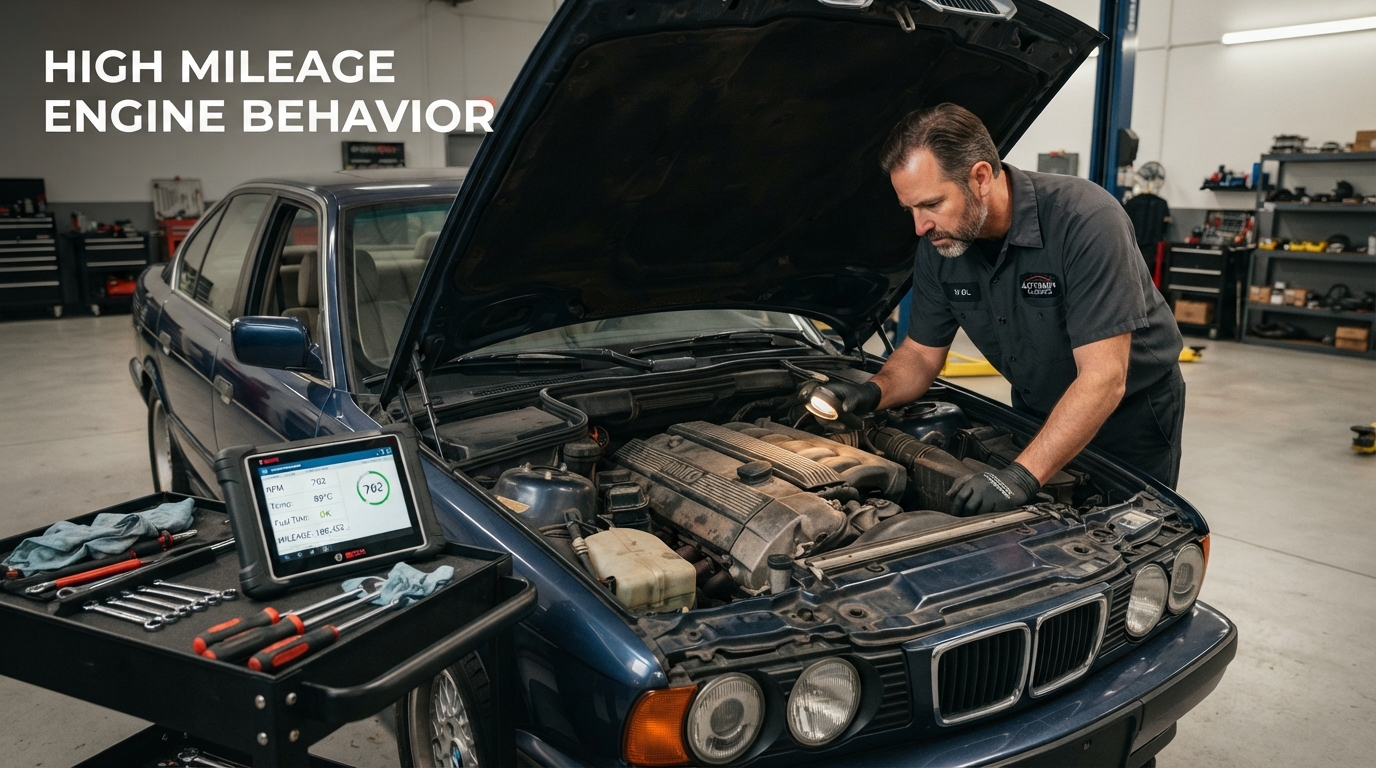
Your car just passed 100,000 miles, and now it makes a sound it never made before. Maybe the oil drops a little between changes. Maybe the engine shakes a bit at a red light. High mileage does not mean your car is finished. It means your engine is telling a new story, and a good inspection knows exactly how to read it.
What “High Mileage” Really Means for Your Engine
For most people, “high mileage” means a car with more than 100,000 miles on it. That number used to scare drivers. It does not scare me. I have watched simple engines run strong past 200,000 miles with basic care. I have also seen neglected engines quit at 90,000. Miles matter, but the way you treat the engine matters far more.
An engine is really just a big air pump that burns fuel to make power. Over the years, tiny parts wear down a small amount. Rubber seals get stiff. Metal rings lose a little grip. In our shop, close to 8 out of 10 high mileage cars come in with problems that stay cheap when caught early. The whole game is catching them before they grow into big bills.
So the mileage number alone does not tell the full story. A well cared for engine at 120,000 miles can be in better shape than a rough one at 70,000. If you want to know how far your motor can really go, our breakdown on how long a car engine lasts walks you through the real limits. The point is simple. Age is a number, but wear is the truth.
How Engine Behavior Changes After 100,000 Miles
I have inspected hundreds of high mileage engines, and they almost always start “talking” in the same order. First a small oil drip. Then a slow leak. Then a new tick or shake. These are not random. They follow a pattern, and once you know the pattern, you can stay ahead of it.
The most common change is oil consumption. As the engine wears, oil sneaks past old piston rings and valve seals and burns off in tiny amounts. In our experience, roughly 3 out of 5 engines past 100,000 miles use at least a little extra oil between changes. That is normal up to a point. It only becomes a worry when you are adding a quart every few hundred miles.
You may also notice more noise. A cold start tick, a light engine knock, or a shake when idling all point to worn parts working harder. Here is a quick look at what these signs usually mean.
| Sign You Notice | What It Often Points To |
|---|---|
| Oil low between changes | Worn rings or valve seals letting oil burn |
| Tick right after cold start | Old lifters or low oil pressure at startup |
| Shake at idle | Worn spark plugs, motor mounts, or misfire |
| Sweet smell + white smoke | Coolant leak, possible head gasket trouble |
| Slow power loss | Clogged fuel, carbon buildup, or weak compression |
None of these mean the engine is done. They mean the engine needs eyes on it. Small changes are the engine’s way of asking for help early, while the fix is still simple and cheap.
The First Things a Professional Inspection Checks
When a high mileage car rolls into the bay, we do not start by pulling parts. We start by looking, listening, and reading the story the car already gives us. A good professional inspection moves from the easy checks to the deep ones, so you never pay for a big test when a small one gives the answer.
The first round covers the basics that catch most problems. In our shop data, about 70% of high mileage issues show up in this first simple pass, long before any heavy work. Here is what we check right away:
- Fluids: oil level, oil color, coolant level, and transmission fluid. Dark, gritty, or milky fluid tells us a lot fast.
- Leaks: fresh drips under the engine, oily buildup on the block, or crusty coolant trails.
- Belts and hoses: cracks, soft spots, or fraying on the serpentine belt and cooling hoses.
- Battery and charging: weak starts on an older car often trace back here, not the engine.
- Warning lights: we pull codes from the computer to see what the car already flagged.
This first look guides everything else. If your car shows early signs but you are not sure what they mean, our guide on engine problems and how to catch them early is a great place to start. Catching trouble in this stage saves the most money, every time.
Compression Test and Leak-Down Test: Reading the Engine’s Health
In my professional experience, nothing tells the true health of a high mileage engine like a compression test. I have had cars that sounded rough but tested strong, and quiet ones that tested weak. Sound can fool you. Numbers do not.
A compression test is simple to picture. Each cylinder squeezes air and fuel to make power. We measure how well each one squeezes. Healthy cylinders usually read close to each other, and the shop rule of thumb is that no cylinder should sit more than about 10% below the others. When one cylinder reads low, we know exactly where to look next.
If a cylinder tests low, we run a leak-down test. That means we push air into the cylinder and listen for where it escapes. Air hissing from the exhaust points to a burned valve. Air from the oil cap points to worn rings. This test turns guessing into knowing, and it can save you hundreds by pointing straight at the real problem. Our full write-up on how an engine compression test works explains it in plain steps.
These two tests are the backbone of any honest high mileage check. They cost little compared to tearing an engine apart. If your motor is losing power or burning oil, this is the smart first deep test to run before spending big money.
Common Warning Signs We See in High Mileage Engines

Some signs show up again and again once a car passes 100,000 miles. The good news is that most of them are easy to spot if you know what to feel and hear. You do not need to be a mechanic to notice these. You just need to pay attention.
Here are the warning signs that bring the most high mileage cars into our shop:
- Blue smoke from the exhaust: the engine is burning oil, often from worn seals or rings.
- Rough idle or shaking: usually a misfire, worn spark plugs, or tired motor mounts.
- Oil that turns black fast: old oil and sludge building up inside.
- Slow, creeping power loss: carbon buildup, clogged fuel parts, or weak compression.
- A steady drip in the driveway: a small leak that can grow into a big one.
I always tell folks that a shaking car is not something to drive around with for weeks. About 1 in 4 shake complaints we see trace back to a simple misfire that got worse from waiting. If your car has started to shake, our page on why your car might be shaking helps you sort a minor fix from a real repair. The sooner you check it, the cheaper it stays.
The pattern here is clear. High mileage engines rarely fail out of nowhere. They warn you first, often for weeks. Listening to those early warnings is the single best way to protect your engine and your wallet.
Fluids, Leaks, and Gaskets: The Silent Trouble
I have handled cases exactly like this many times. A driver ignores a small coolant smell for a month, and what starts as a $40 hose turns into a blown head gasket worth far more. Leaks are the quiet danger of high mileage engines. They start small, and they hide.
The head gasket is a thin seal between the top and bottom of your engine. Its job is to keep oil, coolant, and combustion apart. When it fails, those fluids mix, and you might see white smoke, milky oil, or an engine that runs hot. According to guidance from the U.S. Department of Energy’s FuelEconomy.gov maintenance page, using the manufacturer’s recommended grade of motor oil alone can improve your gas mileage by 1% to 2% and helps parts last longer. Clean, correct fluid is cheap protection.
Coolant leaks deserve special care because overheating is one of the fastest ways to ruin a high mileage motor. Our guide on head gasket failure signs and causes shows what to watch for, and the piece on what low oil does to your engine explains why running low is so risky. Both problems share one lesson.
Small leaks are never really small. They are big repairs in an early stage. Fixing a $30 seal today beats replacing a cracked engine block next season, and it keeps your car safe on the road.
Timing Belt vs Timing Chain: Why Mileage Matters
Timing parts keep the top and bottom of your engine moving in perfect step. Some engines use a rubber timing belt. Others use a metal timing chain. The difference matters a lot once you cross 100,000 miles, because one of them has a hard deadline and the other does not.

A timing belt wears out and must be swapped on a schedule, often between 60,000 and 100,000 miles. If it snaps on many engines, the pistons and valves crash together, and the repair gets very expensive. A timing chain usually lasts much longer, but it can stretch with age and throw off engine timing. Here is how they stack up.
| Feature | Timing Belt | Timing Chain |
|---|---|---|
| Material | Rubber with fibers | Metal links |
| Typical life | 60,000–100,000 miles | Often 150,000+ miles |
| Warning before failure | Little to none | Rattle noise, timing codes |
| Cost of neglect | Very high (bent valves) | High if it jumps or breaks |
| Routine action | Replace on schedule | Inspect, watch for stretch |
If you do not know which one your car has, that is exactly what a good inspection tells you. Our comparison of timing belt versus timing chain breaks it down by engine type. Knowing your setup at high mileage is one of the easiest ways to dodge a surprise breakdown.
Spark Plugs, Carbon Buildup, and the Check Engine Light
In my professional experience, the check engine light is the most ignored warning on the whole dash. People see it, the car still drives, so they wait. That waiting is where small repairs turn into big ones, and high mileage engines have the least room to spare.
The U.S. Department of Energy’s FuelEconomy.gov states plainly that a check engine light can point to problems that raise emissions, cut fuel economy, or lead to costly repairs later, and they urge drivers to get the car inspected when it comes on. I see this weekly. A cheap sensor or a worn plug, left alone, slowly damages other parts. If your light is on but the car feels fine, our page on a check engine light with a car that runs fine explains why you should still check it.
Spark plugs and carbon buildup are two common high mileage culprits. Old plugs cause misfires that waste fuel and shake the car. Carbon is the crusty gunk that builds on valves and slowly chokes airflow. Both are simple to check.
- Worn spark plugs: cause rough idle, weak power, and poor fuel use.
- Carbon buildup: causes stumbling, hesitation, and slow acceleration.
- A steady misfire code: often points to plugs, coils, or fuel delivery.
For the fixes, our guides on when to replace spark plugs and carbon buildup engine symptoms show the signs clearly. If your check engine light is on and you are near Huntsville, bring it by Brian’s Tire and Service. We can pull the codes and tell you what is really going on, no guessing.
Should You Repair, Rebuild, or Replace the Engine?
This is the big question every high mileage owner asks me. The honest answer depends on three things: the cost of the fix, the value of the car, and how the rest of the vehicle looks. There is no single right choice, but there is a smart way to decide.
I tell people to compare the repair cost against the car’s worth. A rough shop rule is this: if a repair costs more than about 50% of what the car is worth, it is time to think hard about replacing the engine or the car. Here is a simple way to see the three paths.
| Option | Best When | Rough Cost Level | What You Get |
|---|---|---|---|
| Repair the part | One clear problem, rest of engine is strong | Low | Fixes the issue, keeps engine as is |
| Rebuild the engine | Good car, worn internals, solid body | Medium–High | Fresh internal parts, longer life |
| Replace the engine | Cracked block, blown internals, but great car | High | A different used or new engine |
A rebuild means we open the engine and replace the worn inside parts. A replacement means we drop in a whole different engine. Both keep a car you love on the road, and both can be smart when the body and transmission are still strong. Our detailed guide on rebuilding versus replacing an engine walks through the math.
The worst choice is guessing. A proper inspection gives you real numbers so you can decide with facts, not fear. Sometimes a $300 repair buys another two years. Sometimes it does not. The only way to know is to look first.
How to Keep a High Mileage Engine Running Strong in Huntsville
I have found that the cars living longest around Huntsville share one habit: steady, boring, on-time care. No magic. No special oil. Just the basics done well, again and again. Our hot summers and hilly roads work engines hard, so care matters even more here.
Small habits protect big money. The Department of Energy’s FuelEconomy.gov driving tips report that hard, aggressive driving can lower your gas mileage by 15% to 30% at highway speeds and 10% to 40% in stop-and-go traffic, which also puts extra strain on an older engine. Gentle driving is not just cheaper. It is easier on tired parts. And if you drive a hybrid, the Alternative Fuels Data Center notes those systems need less routine engine work because they have fewer moving parts, though the gas engine still needs normal care.
Here is the simple care list I give every high mileage owner:
- Change oil on time with the correct grade, and never let it run low.
- Watch your fluids and fix small leaks fast, before they spread.
- Replace spark plugs and filters at the right miles to stop misfires.
- Check belts and hoses twice a year, since heat cracks rubber.
- Get a full inspection once a year to catch trouble early.
If your car recently crossed 100,000 miles and something feels off, let’s take a look together. Bring it by Brian’s Tire and Service in Huntsville, and we can run a full high mileage inspection and show you exactly what needs attention now and what can wait. Staying ahead of wear is how these engines reach 200,000 miles and beyond.
The Bottom Line on High Mileage Engines
A high mileage engine is not a broken engine. It is a seasoned one. It works a little harder, speaks up a little more, and asks for care a bit sooner. Once you learn to read the signs, those miles stop being scary and start being normal. Most of what goes wrong past 100,000 miles is small, cheap, and easy to fix when you catch it early.
The real secret is not luck. It is looking. A proper professional inspection with a compression test, a fluid check, and a good code scan turns mystery noises into clear answers. Fix the small things on time, drive with a light foot, and keep your fluids clean. Do that, and your engine can keep going strong for years. Have you had your high mileage engine checked lately? If not, now is a good time.
Frequently Asked Questions
1. Is 100,000 miles bad for an engine?
No, not on its own. Many engines run well past 200,000 miles with good care. The number matters less than how the car was maintained. A well-kept engine at 120,000 miles often beats a neglected one at 70,000. Care beats mileage every time.
2. How often should a high mileage car get inspected?
At least once a year, plus any time a new noise, leak, or warning light shows up. In our shop, about 70% of high mileage problems appear in a simple first-round check. A yearly inspection catches trouble while it is still small and cheap to fix.
3. Why does my old engine burn oil?
As engines age, oil slips past worn piston rings and valve seals and burns off in tiny amounts. Using a little oil between changes is common at high mileage. It becomes a worry only when you add oil often, like a quart every few hundred miles.
4. What is the most important test for a high mileage engine?
The compression test. It measures how well each cylinder squeezes, which shows the true health inside the engine. If one cylinder reads low, a leak-down test points to the exact cause, so you fix the real problem instead of guessing.
5. Should I repair or replace a high mileage engine?
Compare the repair cost to the car’s value. A common rule is that if the fix costs more than about 50% of the car’s worth, replacing the engine or car may be smarter. A full inspection gives you the real numbers so you can choose with facts, not fear.