
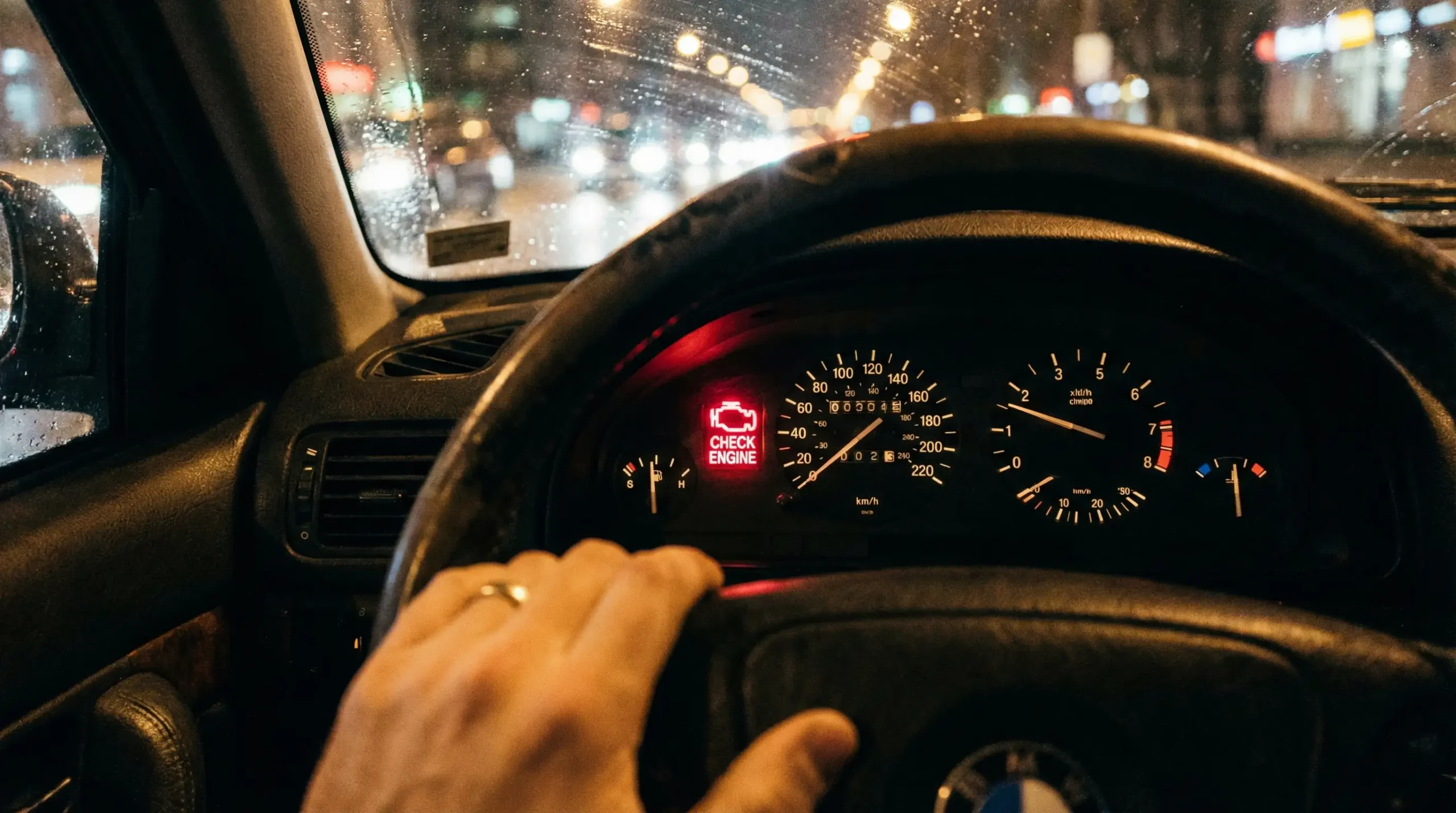
You’re driving to work, music playing, everything feels normal. Then you look down and see it: your check engine light isn’t just on, it’s flashing at you. Your heart sinks a little.
That blinking light is your car’s way of screaming for help. It’s not like when the light just stays on and you think, “I’ll deal with that later.” No, a flashing check engine light means something serious is happening right now.
I know how scary this feels. You might wonder if your car will break down any second or if you’re about to spend a fortune at the shop. The good news? If you act fast, you can stop a small problem from turning into a huge mess.
What Does a Flashing Check Engine Light Mean?
Your car has a smart system called the onboard diagnostic system. It watches over your engine and lets you know when something goes wrong.
When the check engine light stays solid, it means there’s a problem, but you usually have time to fix it. You can drive to a shop without panic.
But when that same light starts flashing? That’s different. That’s urgent.
The Difference Between Steady and Flashing Lights
- A steady light is like your car saying, “Hey, something’s not right. Get it checked soon.”
- A flashing light is your car screaming, “Stop! Something bad is happening right now!”
The main difference is how serious the problem is. A steady light might mean your gas cap is loose or an oxygen sensor needs changing. You can usually keep driving for a bit.
A flashing light almost always means your engine is misfiring. That’s when one or more of your engine’s cylinders aren’t firing the way they should. This sends unburned fuel into your exhaust system, which can overheat and damage your catalytic converter—one of the most expensive parts to replace.
Why This Is an Emergency (Not Just a Warning)
Here’s the truth: driving with a flashing check engine light is dangerous for your car.
When your engine misfires, it’s not burning fuel correctly. That extra fuel goes into the exhaust system and makes your catalytic converter get super hot. If it gets too hot, it can break completely.
Replacing a catalytic converter can cost anywhere from $1,000 to $2,500 or more, according to AAA. That’s a lot of money for something you could have avoided by stopping sooner.
Plus, the longer you drive, the worse other parts can get damaged too—like your spark plugs, ignition coils, or even the engine itself.
Can You Drive with a Flashing Check Engine Light?
Short answer: No, you shouldn’t.
I get it. You might be late for work, or you’re far from home, or you just don’t want to deal with it. But trust me, this isn’t something to ignore.
The Immediate Danger to Your Engine
When your engine misfires, it’s like trying to run with one leg that doesn’t work. The other parts work harder to make up for it, and that causes stress.
You might notice your car:
– Shaking or vibrating more than usual
– Making strange popping or sputtering sounds
– Losing power when you step on the gas
– Running rough or jerking while you drive
All of these are signs that your engine is struggling. And every second you keep driving, you’re making it worse.
What Happens If You Keep Driving
If you ignore the flashing light and keep going, here’s what can happen:
1. Your catalytic converter overheats and breaks (very expensive)
2. More unburned fuel damages other parts
3. Your engine could stall or shut down completely
4. You might get stranded on the side of the road
5. What started as a $200 fix could turn into a $2,000+ repair
I once knew someone who kept driving because they “just needed to get home.” By the time they got there, their catalytic converter was fried, and they ended up paying three times what the original repair would have cost.
Don’t be that person. Pull over as soon as it’s safe.
Common Reasons Your Check Engine Light Is Flashing
So what actually causes this scary flashing light? Let me break down the most common reasons.
Engine Misfire: The Number One Cause
An engine misfire is when one (or more) of your engine’s cylinders doesn’t fire correctly during the combustion process.
Think of your engine like a team of workers. Each cylinder is supposed to do its job at the right time. When one worker stops working, the whole team suffers.
This happens when:
– The spark doesn’t happen at the right time
– There’s not enough fuel getting to the cylinder
– The air and fuel aren’t mixing right

You’ll feel the car shake or vibrate, especially when you’re stopped at a red light. You might also notice it has trouble speeding up or feels weaker than normal.
A study published by the Society of Automotive Engineers shows that engine misfires are the leading cause of catalytic converter failure, making quick diagnosis super important.
Ignition System Problems (Spark Plugs, Coils, Wires)
Your ignition system is what creates the spark that lights the fuel in your engine. If any part of this system fails, you get a misfire.
The most common problems are:
Bad Spark Plugs
These little parts create the spark your engine needs. Over time, they wear out, get dirty, or just stop working. If you haven’t changed your spark plugs in a long time (usually every 30,000 to 100,000 miles depending on the type), they might be the problem.
Failing Ignition Coils
These turn your battery’s power into a strong spark for the spark plugs. When they fail, no spark happens, and you get a misfire. Cars older than 6-8 years often have this issue.
Damaged Spark Plug Wires
The wires carry electricity to the spark plugs. If they’re cracked or broken, the spark can’t get through.
Fixing these parts usually isn’t super expensive—maybe $100 to $400 total, depending on your car. But if you wait too long and damage other parts, it gets way more costly.
Fuel System Issues That Cause Flashing Lights
Your engine needs the right amount of fuel at the right time. If something messes that up, you get problems.
Bad Fuel Injectors and Pump Problems
Fuel injectors spray fuel into your engine’s cylinders. If they get clogged with dirt or gunk, they can’t do their job right. Too little fuel means a weak combustion. Too much fuel floods the cylinder.
Your fuel pump pushes gas from your tank to the engine. If it’s weak or failing, your engine won’t get enough fuel, especially when you’re driving fast or going uphill. This causes misfires.
Signs of fuel system problems:
– The car hesitates when you press the gas
– Engine sputters or jerks
– Harder to start the car
– Smell of gas (which could mean a leak)
One time, my friend’s car started acting weird on the highway. Turned out the fuel pump was dying. Luckily, she got it checked before it quit completely.
Loose or Damaged Gas Cap
This might sound silly, but a loose gas cap really can cause problems.
Your car’s fuel system needs to stay sealed tight. If the gas cap isn’t on all the way, air gets in and messes up the pressure. This confuses your car’s sensors and can make the check engine light come on—or even flash in some cases.
The fix? Just tighten your gas cap until you hear it click a few times. Drive for a little while and see if the light goes away. If it does, great! You just saved yourself a trip to the shop.
Failing Sensors and Their Role
Your car has tons of sensors that help it run smoothly. When they fail, things go wrong fast.
Oxygen Sensor and Mass Airflow Sensor Failures
The oxygen sensor checks how much oxygen is in your exhaust gases. It tells your car’s computer how to adjust the fuel-air mixture.
If this sensor fails, your car might:
– Use too much gas
– Run rough
– Have trouble passing emissions tests
A bad oxygen sensor usually causes a steady check engine light, but if it’s really messed up and causes misfires, the light might flash.
The mass airflow sensor measures how much air is coming into the engine. If it gets dirty or breaks, your car won’t know how to balance the air and fuel. This can lead to poor performance and misfires.
Crankshaft Position Sensor Issues
This sensor tells your car’s computer where the crankshaft is and how fast it’s spinning. This info is super important for spark timing and fuel injection.
When it fails, your car loses track of when to fire the spark plugs, and you get misfires. In bad cases, your car might not start at all.
If your car suddenly stalls while driving or won’t start, a bad crankshaft position sensor could be why.
What to Do When Your Check Engine Light Starts Flashing
Okay, so the light is flashing. Don’t panic. Here’s exactly what to do.
Immediate Steps to Take
Step 1: Reduce Your Speed
Slow down right away. Don’t speed up or drive hard. Less stress on your engine means less damage.
Step 2: Pull Over Safely
Find a safe spot to pull over—a parking lot, gas station, or the side of the road if you have to. Turn on your hazard lights.
Step 3: Turn Off the Engine
Once you’re stopped, turn off your car. Let it sit for a minute. This gives everything a chance to cool down.
Step 4: Check the Basics
Pop the hood and look around. Is anything smoking? Do you smell burning? Is your gas cap loose? Sometimes it’s something simple.
Step 5: Restart and Test
Turn the car back on. Is the light still flashing? If yes, don’t keep driving. If it’s now steady (not flashing), you might be okay to drive carefully to a shop, but don’t push it.
When to Call for a Tow
If any of these things happen, call for a tow truck:
– The light keeps flashing after you restart
– Your car is shaking really badly
– You hear loud banging or knocking sounds
– The car stalls or won’t stay running
– You see smoke or smell something burning
Yes, a tow costs money. But it’s way cheaper than a new catalytic converter or engine repair.
Most car insurance includes roadside assistance. Check your policy. You might already have free towing.
How Mechanics Diagnose a Flashing Check Engine Light
Once you get your car to a shop, here’s what happens.
Using OBD-II Scanners and Diagnostic Tools
Every car made after 1996 has an OBD-II port. It’s usually under the steering wheel.
Mechanics plug a scan tool into this port to read the diagnostic trouble codes stored in your car’s computer. These codes tell them what went wrong.
For example:
– P0300 = Random or multiple cylinder misfire
– P0301 = Cylinder 1 misfire
– P0420 = Catalytic converter problem
The codes don’t tell the whole story, though. They just point mechanics in the right direction. Then they do more tests to find the exact cause.
Common Diagnostic Trouble Codes (DTCs)
Here are some common codes you might see with a flashing check engine light:
- P0300 Series – Misfire codes (P0300, P0301, P0302, etc.)
- P0171/P0174 – Engine running too lean (not enough fuel)
- P0172/P0175 – Engine running too rich (too much fuel)
- P0420/P0430 – Catalytic converter efficiency issues
- P0134 – Oxygen sensor problems
Good mechanics don’t just replace parts based on codes. They test everything to make sure they fix the real problem.
How Much Does It Cost to Fix a Flashing Check Engine Light?
I know you’re wondering about the money. Let me be honest with you.
Average Repair Costs by Issue
Here’s what you might pay, depending on what’s wrong:
- Spark Plugs: $100 – $300
- Ignition Coils: $200 – $400 per coil
- Fuel Injectors: $300 – $800
- Oxygen Sensor: $200 – $500
- Mass Airflow Sensor: $250 – $450
- Catalytic Converter: $1,000 – $2,500+
- Fuel Pump: $400 – $900
These are rough numbers. Your actual cost depends on your car’s make and model, where you live, and which shop you use.
Dealer shops usually cost more than independent mechanics. But sometimes they know your car better.
Preventing Expensive Catalytic Converter Damage
The catalytic converter is the most expensive part you could damage by driving with a flashing light.
According to the EPA, this part reduces harmful emissions by up to 90%. It’s super important for the environment and required by law.
To protect it:
– Stop driving when you see a flashing light
– Keep up with regular maintenance
– Use good-quality gas
– Replace spark plugs and other parts on time

Spending $200 now on spark plugs beats spending $2,000 later on a catalytic converter.
Conclusion
A flashing check engine light is your car’s emergency alarm. It’s not something to ignore or “deal with later.”
Remember: a flashing light almost always means an engine misfire, and driving makes it worse. You could turn a small, cheap fix into a huge, expensive problem.
The smart move? Pull over, turn off your engine, and get help. Whether it’s a tow or a careful drive to a shop, don’t risk it.
Your car is trying to protect itself—and you. Listen to it. Get it checked out right away, and you’ll save money, stress, and maybe even your engine.
Stay safe out there, and don’t ignore that flashing light!
FAQs
1. What’s the difference between a flashing and a solid check engine light?
A solid light means there’s a problem you should fix soon, but it’s not an emergency. A flashing light means your engine is misfiring right now and could be damaging expensive parts like the catalytic converter. You should stop driving immediately when the light flashes.
2. Can a loose gas cap really cause the check engine light to flash?
A loose gas cap usually causes a solid check engine light, not a flashing one. But it can mess up your fuel system’s pressure and cause other problems. Always check and tighten your gas cap first—it’s the easiest fix and might save you a trip to the mechanic.
3. How long can I drive with a flashing check engine light before serious damage happens?
You shouldn’t drive at all with a flashing light. Serious damage can start happening in just minutes. Every time your engine misfires, unburned fuel goes into your exhaust and overheats your catalytic converter. The longer you drive, the more damage you cause and the higher your repair bill will be.
4. Will my car pass emissions testing with a flashing check engine light?
No, your car will fail emissions testing if the check engine light is on at all—flashing or solid. Plus, if your engine is misfiring, it’s putting out way more harmful emissions than normal. You need to fix the problem first, then let your car’s computer reset before testing.
5. Can I just reset the check engine light myself instead of fixing the problem?
You can reset it by disconnecting your battery or using a scan tool, but that doesn’t fix what’s wrong. The light will just come back on, probably even faster if it was flashing. Plus, you’ll lose all your car’s computer data. It’s way better to find and fix the real problem instead of hiding it.