
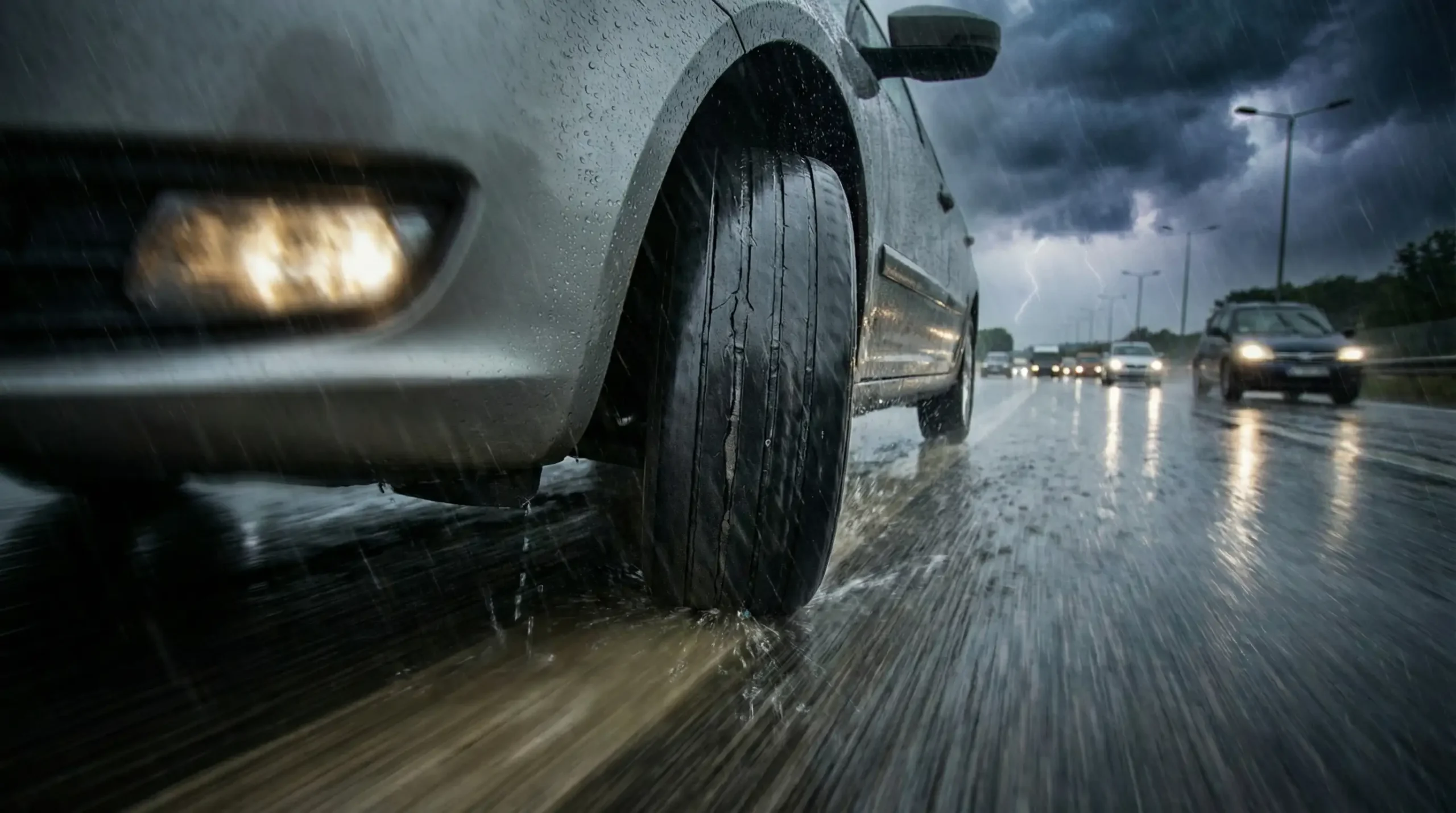
Last summer, I was driving home when rain started falling hard. The car in front of me stopped suddenly, and I hit my brakes. My car slid forward, and my heart jumped. I barely stopped in time. Later, I checked my tires and found they were almost bald. That close call taught me a lesson I’ll never forget.
What Are Bald Tires?
Understanding Tire Tread and Its Purpose
Your tires are the only part of your car that touches the road. The tread is the rubber pattern you see on the outside of the tire. It has grooves and cuts that help your car grip the road.
These grooves do more than just look nice. They push water away when you drive in the rain. They also help your tires hold onto the road when you turn or stop. Without good tread, your tires can’t do their job well.
Think of tread like the grooves on your shoe bottom. When those grooves wear down, you slip more easily. The same thing happens with your tires.
When Tires Become “Bald” – The 2/32 Inch Rule
A tire becomes “bald” when its tread wears down to 2/32 of an inch. That’s very shallow, about the width of a thin coin edge.
New tires start with about 10/32 of an inch of tread depth. As you drive, this tread slowly wears away. According to the U.S. Department of Transportation, tires at or below 2/32 of an inch are no longer safe to use.
Most tires have built-in wear bars. These are small raised sections inside the grooves. When the tread wears down to the same level as these bars, your tire is bald and needs to be replaced right away.
Why Bald Tires Are Extremely Dangerous in Wet Weather
Loss of Traction on Wet Roads
When I drove with worn tires that rainy day, I learned something scary. Bald tires lose their ability to grab wet roads.
Tread grooves are like tiny channels. They squeeze water out from under your tire as you drive. This lets the rubber touch the actual road surface. When the tread is worn down, there’s nowhere for the water to go.
A study published by Consumer Reports showed that tires with half their tread took 3 to 6 feet longer to stop on wet roads compared to new tires .That extra distance can mean the difference between a safe stop and a crash.
On wet surfaces, bald tires can’t grip properly. This makes it hard to steer, turn, or stop. You might press the brake pedal, but your car keeps sliding.
Hydroplaning – When Your Tires Lose Contact With the Road
Hydroplaning is one of the scariest things that can happen when you drive. It happens when a layer of water builds up between your tire and the road.
When this happens, your tire actually floats on top of the water. You’re no longer touching the road at all. Your steering wheel won’t work. Your brakes won’t work. You have zero control.
Research from Consumer Reports found that worn tires can start hydroplaning at speeds as low as 40 mph, while new tires maintain contact until about 3 to 4 mph faster. Even a few miles per hour can make a big difference in safety.
The deeper your tread, the more water it can push away. Bald tires have very shallow grooves, so water has nowhere to go. This makes hydroplaning happen much more easily.
The Science Behind Wet Weather Tire Performance
How Tread Grooves Channel Water Away
Let me explain how tread grooves work in a simple way. Imagine you’re pouring water on a smooth table. The water spreads everywhere and stays on the surface.
Now imagine the same table has small channels cut into it. The water flows into those channels and runs off the sides. Your tire tread works the same way.
As your tire rolls forward, the grooves catch water and push it out to the sides. This happens very fast, many times per second. The rubber between the grooves then touches the dry road underneath.
Tires also have smaller cuts called sipes. These are thin slits that help squeeze out even more water. Both grooves and sipes work together to keep your tire in contact with the road.
What Happens When Tread Depth Decreases
As the tread wears down, it can’t move as much water. Shallow grooves fill up quickly with water and can’t be cleared fast enough.
When tread depth drops to half of what new tires have, performance in wet weather drops significantly. You might not notice this on dry roads, but rain changes everything.
The contact patch is the small area where your tire touches the road. On bald tires, water stays in this area instead of being pushed out. This creates a slippery layer between you and the road.
Sipes also wear away as tires age. Without these tiny cuts, your tire loses even more of its ability to grip wet surfaces. This is why old tires with shallow tread are so dangerous when it rains.
Increased Stopping Distances in Rain
Braking Performance Comparison – New vs Worn Tires
I want you to picture this. You’re driving at 40 mph in the rain. Something runs into the road and you need to stop fast.
With new tires, you might stop in about 120 feet. But with bald tires, you could need 170 feet or more to stop completely. That’s an extra 50 feet where you’re still moving.
According to testing by Consumer Reports, tires at half tread depth took 3 to 6 feet longer to stop from 40 mph on wet pavement with antilock brakes engaged. And remember, that’s at half tread, not even bald yet.
Your brakes don’t actually stop your car. Your tires do. Brakes slow down your wheels, but it’s the tire’s grip on the road that stops you. Without good tread, that grip disappears in wet conditions.
The Extra Feet That Could Save Your Life
Let’s talk about what those extra feet really mean. A car is about 15 feet long. So 50 extra feet is more than three car lengths.
Think about all the things that could be in those extra three car lengths. Another car. A person crossing the street. A stopped school bus. These are real dangers that good tires help you avoid.
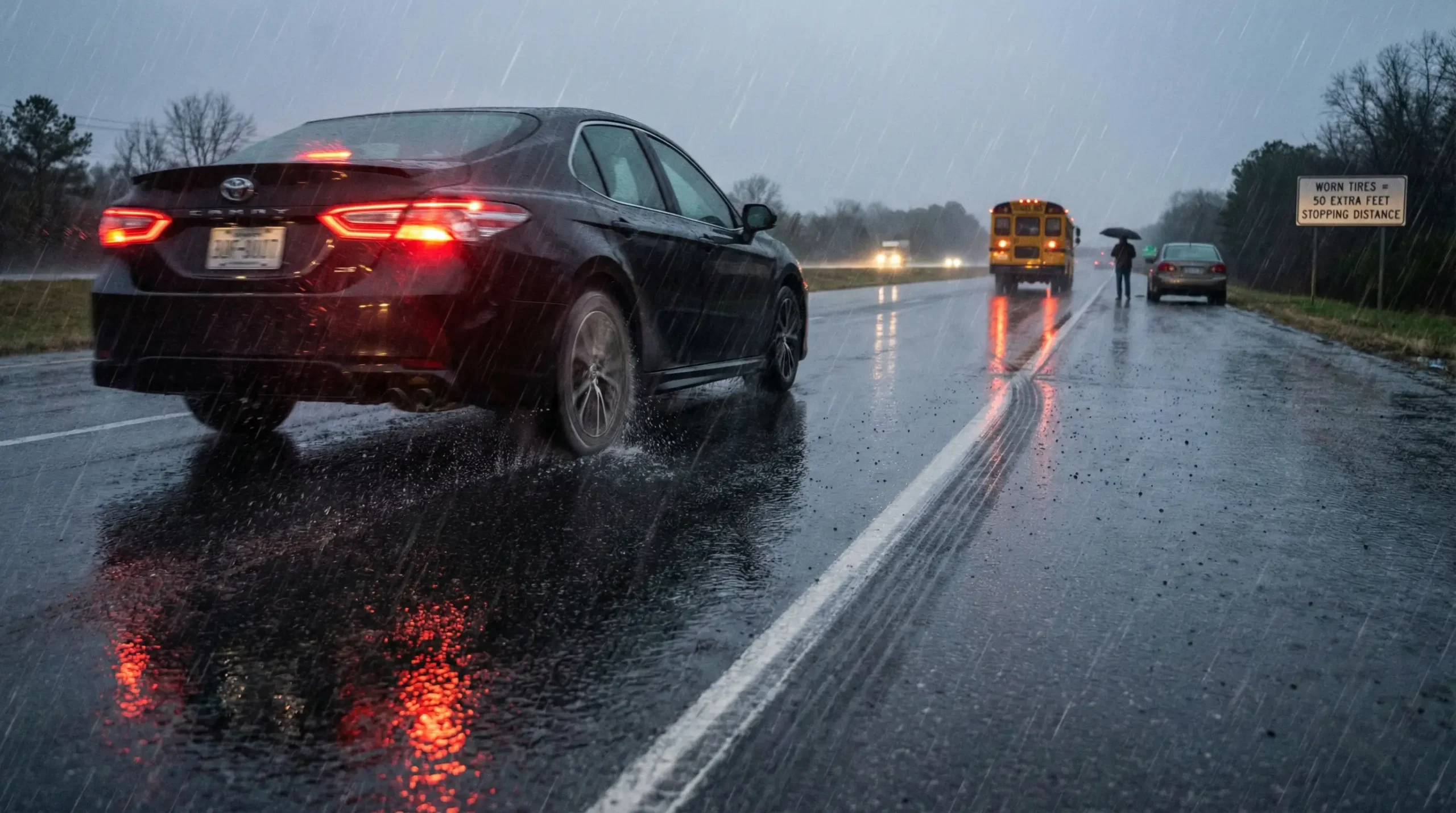
The faster you’re going, the worse it gets. At highway speeds of 60 or 70 mph, the difference becomes even bigger. What should be a quick stop becomes a long, scary slide.
I’ve seen accidents happen because someone couldn’t stop in time. Often, the driver says they hit the brakes, but nothing happened. In many cases, worn tires were part of the problem.
Additional Risks of Driving on Bald Tires
Tire Blowouts and Sudden Failures
Bald tires don’t just slide in the rain. They can also blow out suddenly while you’re driving.
The tread protects the inner part of your tire. When tread is gone, the tire’s structure becomes weak. Sharp objects on the road can penetrate more easily.
Heat also builds up more in bald tires, especially at highway speeds. This extra heat can cause the tire to fail suddenly. One minute you’re driving fine, the next minute you hear a loud bang and lose control.
A tire blowout at high speed is very dangerous. Your car can swerve into other lanes. You might hit the curb or flip over. Even if you don’t crash, you’re stuck on the side of a busy road, which is also risky.
Poor Performance in Snow and Ice
Wet weather isn’t the only problem. Bald tires are also terrible in snow and ice.
Testing showed that tires at half tread depth took about 12 feet longer to reach 20 mph on snow compared to new tires. This is almost 15 percent less snow traction overall.
Snow needs deep grooves and sipes to work properly. These features bite into the snow and create grip. When they’re worn away, your car just spins its wheels.
Ice is even worse. With bald tires on ice, you have almost no control. Stopping is nearly impossible. Turning doesn’t work well. It’s like trying to drive on a skating rink.
Many people wait until winter to check their tires. By then, it might be too late. If you live somewhere with rain or snow, check your tread before bad weather arrives.
How to Check If Your Tires Are Bald
The Penny Test – A Simple Home Check
You don’t need special tools to check your tires. All you need is a penny.
Here’s what you do. Take a penny and hold it with Lincoln’s head pointing down. Put the edge of the penny into one of your tire’s grooves.
Look at Lincoln’s head. If you can see the top of his head above the tread, your tire is too worn. It’s at or below 2/32 of an inch and should be replaced.
Do this test in several spots around each tire. Sometimes tires wear unevenly. One part might be fine while another part is bald. Check the inside, middle, and outside of the tread.
I check my tires this way every month. It takes less than five minutes and could save your life. It’s a simple test that every driver should know.
Reading Tire Wear Indicators and Wear Bars
Most modern tires have built-in wear indicators. These are small raised bars that run across the grooves of your tire.
Look closely at your tire’s grooves. You’ll see these bars at the bottom. When your tread wears down to the same height as these bars, the tire is at 2/32 of an inch.
If the bars are flush with the tread surface, your tire is legally bald. In most states, you can get fined for driving with tires in this condition.
You should also look for other signs of wear. Check for cracks in the sidewall. Look for bulges or bumps that shouldn’t be there. Feel for uneven spots where one area is more worn than others.
Uneven wear often means your alignment is off or your tires aren’t balanced properly. Get these problems fixed to make your tires last longer and drive more safely.
When Should You Replace Your Tires?
Don’t Wait Until 2/32 Inch
Here’s something important. Just because 2/32 inch is the legal minimum doesn’t mean it’s safe.
By the time your tires reach 2/32 inch, they’ve already lost most of their wet-weather grip. You’re driving on tires that can’t protect you properly.
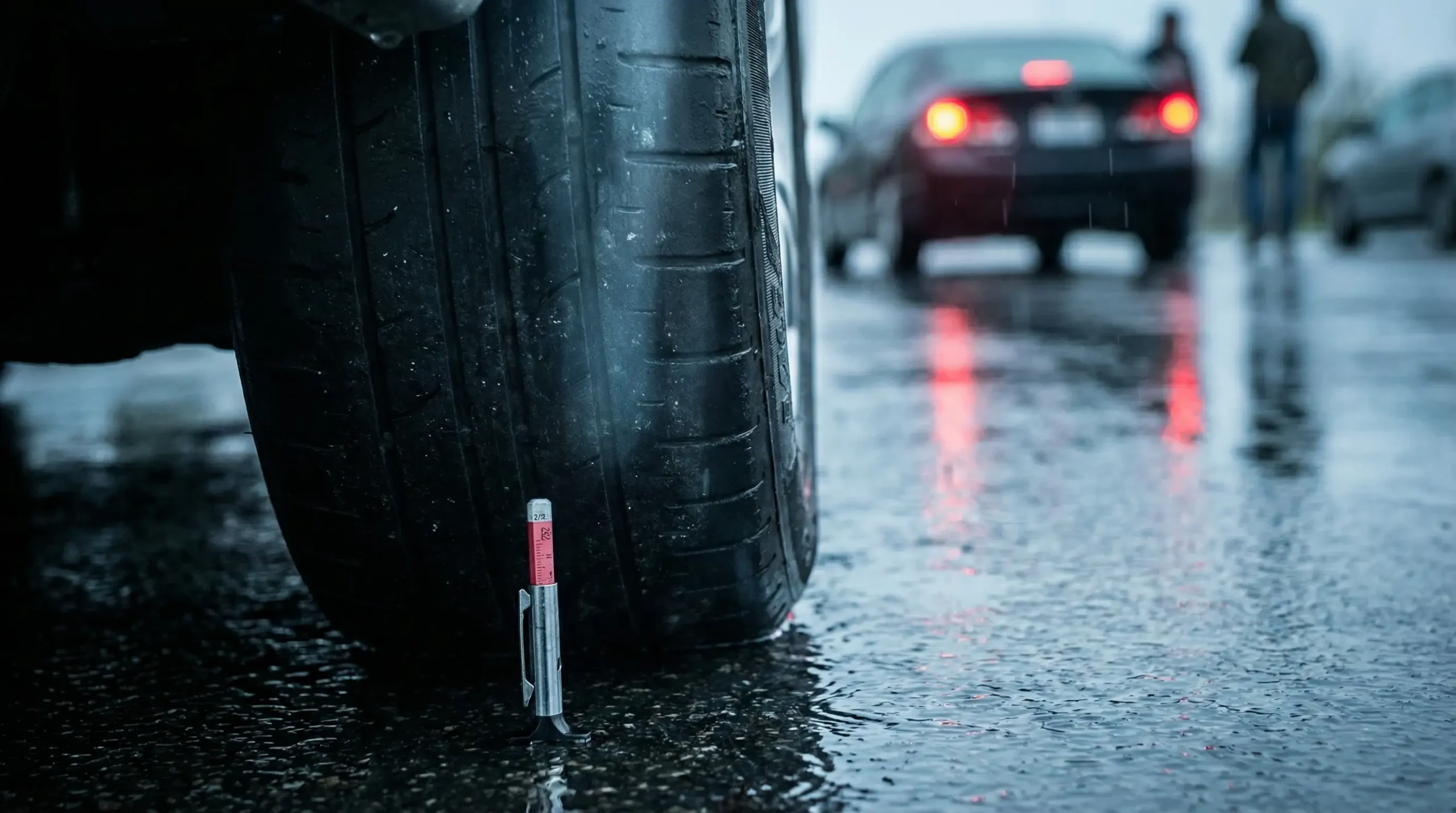
I learned this the hard way. I waited too long to replace my tires because they were “still legal.” But legal and safe are not the same thing.
Think about it this way. Would you wait until your brakes completely fail before fixing them? Of course not. The same thinking should apply to your tires.
Tires are not expensive compared to the cost of an accident. A set of tires might cost a few hundred dollars. A car accident can cost thousands, not to mention possible injuries.
The 4/32 Inch Recommendation for Wet Climates
Many experts now say you should replace tires when they reach 4/32 of an inch, not 2/32 inch. This is especially true if you drive in the rain.
At 4/32 inch, your tires still have some tread left. But wet weather performance has already dropped a lot compared to new tires. The grooves just aren’t deep enough to handle heavy rain well.
If you live in a place that gets a lot of rain or snow, don’t wait. Replace your tires at 4/32 inch. The extra safety is worth the cost.
You can measure this with a quarter instead of a penny. Put the quarter into the groove with Washington’s head down. If you can see the top of his head, you’re at or below 4/32 inch.
Also, remember that tires age even if you don’t drive much. Rubber breaks down over time. Most tire makers say to replace tires every six to ten years, even if the tread looks okay.
Conclusion
Bald tires in wet weather are a serious danger that many drivers don’t think about enough. When your tread wears down, you lose the protection you need when it rains. Hydroplaning becomes easy, stopping distances grow longer, and control disappears.
The good news is that checking your tires is simple. Use the penny test once a month. Look for wear bars. Don’t wait until your tires are completely bald. If you drive in rain or snow often, replace tires at 4/32 inch instead of waiting for 2/32 inch.
Your tires are your connection to the road. They’re the only things keeping your car under control. When they’re worn out, everything else fails too. Take care of your tires, and they’ll take care of you. Stay safe out there, especially when the weather turns bad.
Frequently Asked Questions (FAQs)
How long do tires typically last before becoming bald?
Most tires last between three to four years or about 25,000 to 40,000 miles before becoming bald. However, this depends on how you drive, how well you maintain them, and the type of roads you use. Regular tire rotations and proper air pressure can help your tires last longer. If you drive a lot in city traffic with frequent stops, your tires might wear faster than someone who mostly drives on highways.
Can I drive on bald tires if the weather is good?
No, you should never drive on bald tires, even in good weather. While bald tires perform slightly better on dry pavement than worn tires, they’re still dangerous. Bald tires are more likely to blow out, get punctured, or fail suddenly. They also don’t handle emergency stops well, even on dry roads. Plus, the weather can change quickly, and you don’t want to be caught in the rain with bald tires. Replace them as soon as they reach 2/32 inch or show wear bars.
What is hydroplaning, and why is it dangerous?
Hydroplaning happens when a layer of water builds up between your tire and the road surface. Your tire actually floats on this water layer and loses all contact with the road. When this occurs, you can’t steer, brake, or control your car at all. Hydroplaning can start at speeds as low as 40 mph with worn tires. It’s dangerous because you have zero control over your vehicle until the tire makes contact with the road again, which could take several seconds.
Are there legal requirements for tire tread depth?
Yes, most states in the U.S. require tires to have at least 2/32 inch of tread depth. Driving with tires below this depth is illegal and can result in fines. Some states have stricter rules for commercial vehicles. For example, front tires on buses often need at least 4/32 inch of tread. If you’re in an accident and investigators find your tires were below legal limits, you could be held responsible and your insurance might not cover damages.
How much does it cost to replace bald tires?
The cost to replace bald tires varies based on your vehicle and the type of tires you choose. On average, a single tire can cost between $50 $200 for standard cars. High-performance or specialty tires can cost $200 to $500 or more each. A full set of four tires usually costs $200 to $800 for most vehicles. While this might seem expensive, it’s much cheaper than paying for accident repairs, higher insurance premiums, or medical bills from a crash caused by bald tires.