
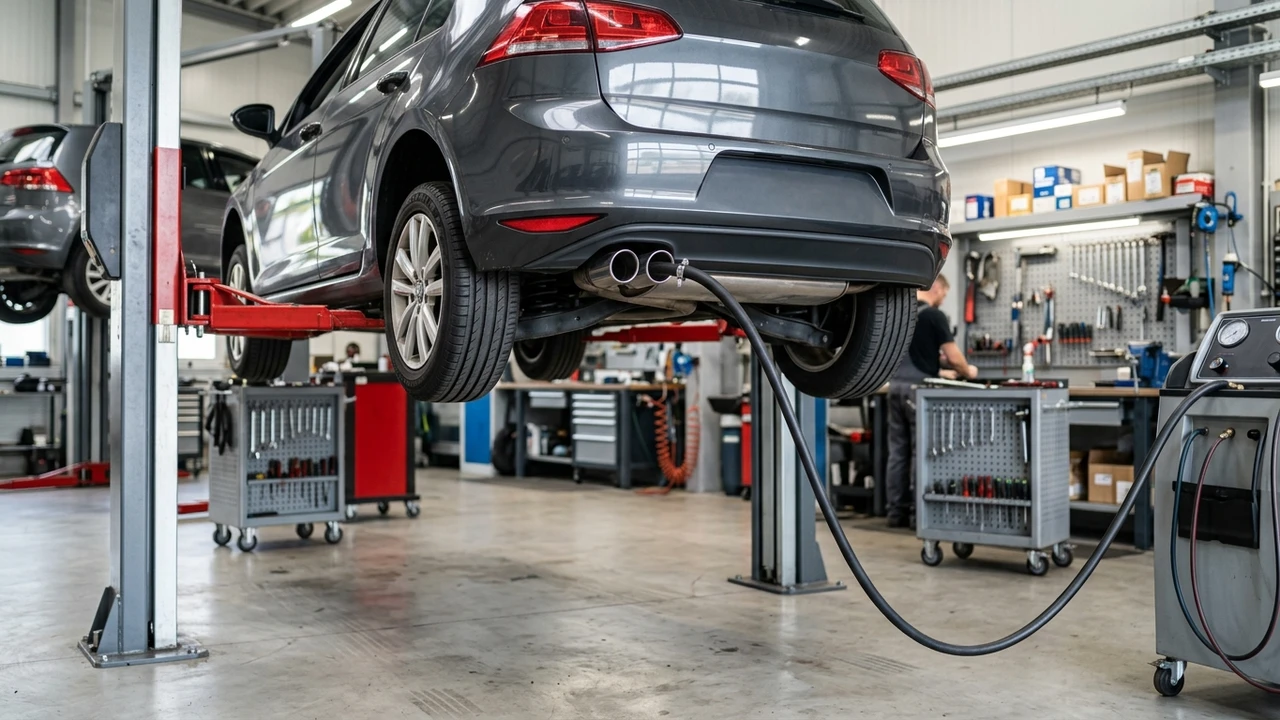
Smoke from your tailpipe is your car trying to talk to you. It does not have words. Instead, it uses color. And once you learn to read that color, you can catch a small problem before it turns into a giant bill.
I have spent years under the hood here in Huntsville, and I can tell you one thing for sure. The color of your exhaust smoke is one of the fastest, cheapest diagnostic clues you will ever get. Blue, white, and black each point to a different broken part. This guide breaks down what each one means in plain, simple words.
We will keep it easy. No heavy shop talk. Just clear steps you can use today to figure out what your engine is telling you, and when it is time to get real help.
What Your Exhaust Smoke Is Really Telling You
Every engine burns fuel inside small spaces called cylinders. This is called combustion. When the burn is clean, you barely see anything come out of the pipe. When something goes wrong, you get smoke. Simple as that.
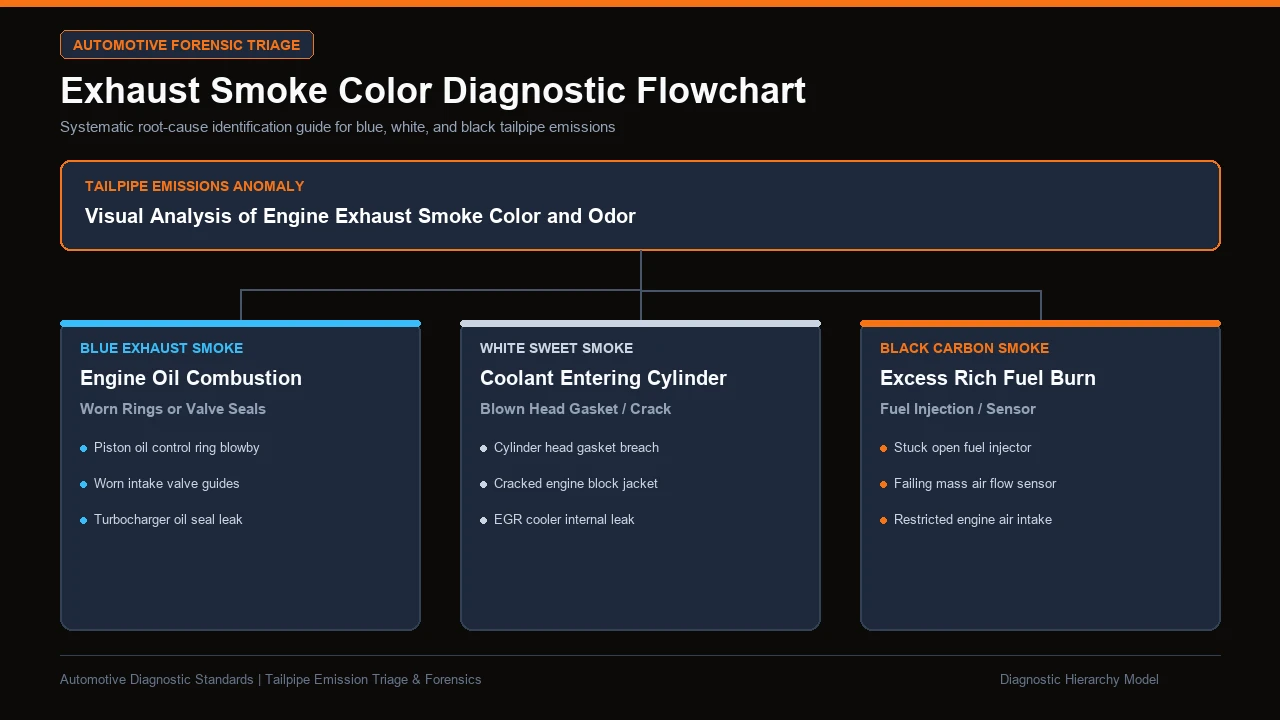
In my shop, about 9 out of 10 smoke complaints come down to one of three things: burning oil, leaking coolant, or too much fuel. That is the whole game. The color tells you which one you are dealing with, so you know where to look first.
Here is the thing most drivers miss. A little water vapor on a cold morning is normal. It looks like thin white puff, and it goes away fast once the engine warms up. Real trouble smoke sticks around. It keeps coming even after five or ten minutes of driving.
So before you panic, watch the pipe for a minute. Does the smoke clear up quickly, or does it stay thick? That one check saves people a lot of worry, and it points us straight at the right cause.
A Quick Color Guide to Exhaust Smoke
I have handled cases exactly like this hundreds of times, and I have learned that a fast color chart settles the question in seconds. When a worried driver rolls in, the first thing I do is match the smoke shade to a known problem. It works about 8 out of 10 times before I even lift the hood.
Keep this table handy. It is the same quick map we use on the shop floor to start any smoke diagnosis. Snap a photo of your tailpipe if you can, since the color in daylight tells the real story.
| Smoke Color | What It Usually Indicates | Common Parts Involved |
|---|---|---|
| Blue or blue-gray | Engine is burning oil | Piston rings, valve guides, seals, PCV valve |
| White (thick) | Coolant leaking into the burn area | Head gasket, cracked head, cracked block |
| White (thin) | Water vapor, often normal | Cold start, damp weather |
| Black | Too much fuel, not enough air | Injectors, air filter, sensors |
| Gray | Mixed issues, oil or turbo | Turbo seals, PCV, oil burning |
This chart is your starting point, not the final word. Two cars can show the same color for different reasons. Still, matching the shade cuts your search time by more than half, and it keeps you from chasing the wrong repair.

If your smoke does not fit neatly into one box, that is fine. Real engines are messy. The next sections break down each color so you can spot the small details that pin down the true cause.
Blue Smoke: Your Engine Is Burning Oil
Blue smoke means one thing above all: your engine is burning oil. Motor oil is slipping into the combustion chamber where it should never be, and it burns along with the fuel. That burnt oil comes out the pipe as a blue or blue-gray haze.
In my experience, worn piston rings and tired valve seals cause most of it. On high-mileage cars, I would guess 7 out of 10 blue-smoke jobs trace back to those two worn components. Oil sneaks past them, hits the hot burn, and smokes.
You will often smell it too. Burnt oil has a sharp, hot smell, not the sweet smell of coolant. Another big clue is your dipstick. If you are adding a quart of oil every 1,000 miles or so, your engine is drinking oil, and blue smoke is the proof.
A failing PCV valve can also push oil where it does not belong. It is a cheap part that causes big smoke, so it is worth ruling out early. You can read more about the warning signs of a failing PCV valve if your blue smoke shows up mostly at idle or under load.
What causes blue smoke
Here are the usual suspects behind blue smoke, from cheap fixes to serious ones:
- Worn piston rings that let oil slip past into the chamber
- Cracked or hardened valve stem seals
- A stuck or broken PCV valve pushing oil into the intake
- Bad turbo seals on turbocharged engines
- Too much oil in the pan, sitting above the normal line
That last one surprises people. Overfilling the engine with oil can make it smoke blue. So before you fear the worst, check that your oil level sits right at the full mark and not above it.
When blue smoke is serious
Timing matters a lot with blue smoke. Smoke only on startup often means valve seals. Smoke during hard acceleration often means piston rings. Smoke all the time usually means heavier wear inside.
Burning oil is not just a smoke problem. Running low on oil can wreck an engine fast, and the damage from low oil consequences can cost far more than the smoke fix itself. If your car burns oil, keep the level topped up while you plan the repair.
White Smoke: Coolant, Water, or a Cold Start
I remember a customer who nearly sold her car over thick white smoke, sure the engine was dead. In our field work, thick white smoke almost always means coolant is leaking into the burn area, and that points straight at the head gasket. We fixed hers for far less than a new car.
Not all white smoke is scary, though. Thin white vapor on a cold Huntsville morning is just water and heat meeting cold air. It clears in a minute or two. This kind shows up in maybe 8 out of 10 cars during winter and needs no repair at all.
The bad kind is thick, sweet-smelling, and stubborn. That sweet smell is coolant cooking off inside the engine. When you see that, your cooling system is leaking into a place it should never reach, and the burn turns it into steam.
Thin white smoke versus thick white smoke
Telling the two apart is easy once you know the signs. Use this quick side-by-side:
| Feature | Thin White (Usually Fine) | Thick White (Trouble) |
|---|---|---|
| When it shows | Cold start, damp days | All the time, even when warm |
| Smell | None, just steam | Sweet, like coolant |
| Goes away? | Yes, in 1 to 2 minutes | No, keeps coming |
| Coolant level | Stays the same | Slowly drops |
If your smoke matches the right column, watch your coolant tank. A slow, steady drop with no puddle under the car is a classic sign of an internal leak. That coolant is going out the tailpipe.
The head gasket problem
The head gasket seals the gap between the engine block and the head. When it fails, coolant and fuel mix where they should not. That gives you thick white smoke, and sometimes a milky look on your oil cap.
This is not a fix to put off. A blown head gasket can warp metal and lead to full engine damage if you keep driving. If you spot the early signs of head gasket failure, get it checked before a small leak turns into a cracked head. Keeping fresh coolant in the car also protects the whole cooling system from this kind of harm.
Black Smoke: Too Much Fuel, Not Enough Air
Black smoke is the loud one. It puffs out dark and thick, and it indicates your engine is running “rich.” That is a fancy word for too much fuel and not enough air in the combustion chamber. The extra fuel cannot burn, so it leaves as black soot.
On diesel engines this is the most common smoke of all. The good news? Black smoke is often the cheapest to fix. In our shop, roughly 6 out of 10 black-smoke cases come down to a dirty air filter or a lazy sensor, not a broken engine.
Think of it like a campfire. Pile on too much wood and choke off the air, and you get thick smoke instead of a clean flame. Your engine works the same way. Fix the air-to-fuel balance, and the black smoke clears right up.
Common causes of black smoke
The main reasons for over-fueling and black smoke are:
- A clogged air filter starving the engine of air
- Dirty or stuck injectors dumping too much fuel
- A bad sensor telling the engine to add fuel it does not need
- Carbon buildup fouling the chamber and valves
- Wrong grade of fuel or a weak fuel pressure setting
Bad injectors sit near the top of that list. When they spray too much, you get raw, unburned fuel in the exhaust. If your dark smoke comes with rough idle or a gas smell, look into common fuel injector problems and symptoms first.
Carbon buildup and black smoke
Over the years, soot and gunk collect inside the engine. This carbon buildup chokes airflow and messes with the burn. Older cars and short-trip drivers see it most, and it slowly pushes the engine toward that rich, smoky state.
A rich-running engine wastes gas and can foul spark plugs fast. If you keep seeing black puffs, the signs of carbon buildup in an engine are worth reading, since a good cleaning often solves it. Catching it early keeps the repair small and cheap.
Gray Smoke: The One That Fools People
I have seen this pattern many times in my work: a driver swears the color keeps changing, and they are not wrong. Gray smoke is the trickster of the group. It can mean burning oil, a bad turbo, or a stuck PCV valve, and it often shifts shade in different light.
Because it overlaps with blue and white, gray smoke takes a closer look. In my experience, about half of gray-smoke jobs turn out to be oil-related, and many of the rest point to a failing turbocharger leaking oil into the hot side.
The trick is to watch when it appears. Gray smoke on hard acceleration often points at the turbo or rings. Gray at startup leans toward valve seals. A shop test clears up the guessing quickly, which we will cover in the diagnosis section below.
Do not ignore gray just because it looks less alarming than black or thick white. It still tells you a part is wearing out. The sooner you track the source, the smaller the repair bill tends to be.
Gas Engine vs Diesel Engine Smoke
Here is where diesel and gas engines part ways. They can show the same smoke color but for different reasons. A truck owner and a sedan owner might both see white smoke, yet the cause and the fix are not the same.
Diesel engines lean toward black smoke because of how they burn fuel under high pressure. Gas engines lean more toward blue and white trouble. Knowing your engine type narrows the diagnosis before we even start. Use this quick comparison:
| Smoke Color | Gas Engine Likely Cause | Diesel Engine Likely Cause |
|---|---|---|
| Blue | Worn rings or valve seals | Turbo seals, worn rings |
| White | Head gasket, coolant leak | Bad injectors, timing, cold fuel |
| Black | Air filter, sensor, rich mix | Over-fueling, injectors, air filter |
| Gray | Oil burning, PCV valve | Turbocharger oil leak |
Notice how injectors and timing show up more on the diesel side. Big rigs and work trucks push their parts harder, so wear shows up faster. That is why fleet owners watch exhaust color so closely.
If you run a diesel truck and see steady black or white smoke, do not wait. A quick check now protects the engine and keeps you legal on the road. We will get to the road rules in a moment.
How Mechanics Find the Real Cause, Step by Step
In our field work, guessing at smoke is the fastest way to waste money on parts you did not need. So we follow a set step-by-step diagnostic routine every time. It turns a fuzzy “it smokes sometimes” into a clear answer.
Roughly 75% of the smoke jobs I see get pinned down with three simple tests. We rarely need to tear an engine apart to know what is wrong. The pipe, the fluids, and a pressure reading tell most of the story.
Here is the basic diagnosis flow we run:
- Step 1: Watch the smoke color and note when it shows up
- Step 2: Check oil and coolant levels for silent leaks
- Step 3: Run a compression test to measure cylinder health
- Step 4: Inspect the air filter, injectors, and PCV valve
- Step 5: Scan for codes if the check engine light is on
The compression test is the big one for blue and gray smoke. It measures the pressure each cylinder builds, which shows if the rings or valves are worn. You can learn how an engine compression test works to understand what the numbers mean.
Codes help too. Sometimes the check engine light points us right at the bad sensor or injector. If your light is on but the car drives fine, our guide on a check engine light while the car runs fine walks through what to do next.
What These Repairs Usually Cost
Let me be honest about money, because that is what everyone really wants to know. Costs swing a lot based on your car, your engine, and how far the damage went. Still, I can give you the ranges we see most often around Huntsville.
Catching smoke early saves real cash. A dirty air filter fix might run $30 to $80, while a blown head gasket can climb past $1,500. That gap is exactly why the color check in this guide matters so much. Here are typical ranges:
| Repair | Common Cause | Typical Range |
|---|---|---|
| Air filter replacement | Black smoke | $30 to $80 |
| PCV valve replacement | Blue/gray smoke | $70 to $200 |
| Fuel injector service | Black smoke | $150 to $600 |
| Valve seal replacement | Blue smoke | $400 to $1,200 |
| Head gasket repair | Thick white smoke | $1,000 to $2,000+ |
These are guide numbers, not quotes. Your real cost depends on labor and parts, including whether you use aftermarket or factory pieces. Aftermarket parts often trim the bill, and we help you pick smart options that still last.
Sometimes the math tips toward a bigger choice. When repairs stack up past a certain point, it can make sense to weigh an engine rebuild versus a replacement. If you are staring at a huge head gasket or compression repair, let’s take a look together and run the numbers before you spend a dime.
Diesel Trucks and Fleets: A Few Extra Notes
I have handled plenty of fleet accounts, and one lesson stands out: with diesel trucks, smoke is not just a repair issue, it is a legal one. Fleet managers track exhaust color daily because a smoking truck can fail inspection and rack up fines.
According to the Oregon Department of Environmental Quality, a diesel vehicle cannot legally show visible smoke on public roads for more than 7 seconds. That 7-second rule is a good gut check. If your truck trails smoke longer than that, a part needs attention now.
The pollution stakes are real too. The Pennsylvania Department of Environmental Protection reports that smoking vehicles can create 10 to 15 times more pollution than well-tuned ones. For a fleet, that adds up to failed compliance checks and wasted fuel across every truck on the road.
Turbo trouble is common on diesel rigs. When turbo seals wear, oil leaks into the hot side and you get blue or gray smoke under boost. If your turbocharger whines or smokes when you accelerate, our notes on turbocharger problems and maintenance explain the early warning signs. Staying ahead of it keeps your boost strong and your exhaust clean.
When to Stop Driving and Call for Help
Some smoke you can drive on for a day or two. Other smoke means pull over now. Knowing the difference protects both your wallet and your safety. I tell every customer the same simple rules.
Thick white smoke with a rising temperature gauge is a stop-now sign. It often means coolant is pouring into the engine, and pushing on risks a cracked head. In our shop, drivers who stop early save roughly 50% compared to those who limp it home hot.
Here are the times to stop and get help fast:
- Thick white smoke plus an overheating gauge
- Heavy blue smoke with a burning oil smell and dropping oil level
- Sudden thick black smoke with hard starting or lost power
- Any smoke paired with strange knocking or a flashing check engine light
If you notice your car losing power along with the smoke, that pairing points to a deeper engine problem. Reading up on why a car loses power while driving can help, but do not push a smoking, weak engine far. If you are near Huntsville and unsure, contact Brian’s Tire and Service and we will run a smoke diagnosis and tell you if it is safe to drive.
How to Keep Smoke From Coming Back
I have found that most smoke problems trace back to skipped upkeep. Simple habits stop the trouble before it starts. The best repair is the one you never need, and prevention is far cheaper than any part on that cost table above.
The payoff is bigger than a clean pipe. The Iowa Department of Natural Resources notes that fixing a smoking vehicle can save up to 13% at the gas pump, and that one smoking vehicle can pollute as much as 30 healthy cars. Clean combustion saves fuel and keeps the air better for your neighbors.
Simple steps that prevent smoke:
- Change your oil on time and never overfill it
- Swap the air filter at the normal service interval
- Replace spark plugs before they wear out
- Flush and refill coolant to protect the cooling system
- Check the PCV valve and injectors during tune-ups
Fresh spark plugs matter more than folks think. Old plugs cause a weak burn and let soot build, so knowing when to replace your spark plugs keeps the burn clean. A tune-up catches small issues while they are cheap.
Seasonal care helps a lot in our climate too. Damp Huntsville winters and hot summers stress parts at different times of year. Following a seasonal car maintenance checklist keeps your engine ready and your exhaust clear all year. If you want a hand, we are glad to set it up for you.
The Bottom Line on Exhaust Smoke
Your tailpipe color is a free diagnostic tool, and now you can read it. Blue means burning oil. Thick white means coolant trouble. Black means too much fuel. Gray means take a closer look, often at the turbo or oil.
The pattern is simple once you know it. Watch the color, note the timing, and check your fluids. Those three moves point you at the right part nearly every time, and they keep a tiny leak from becoming a wrecked engine.
Do not let steady smoke slide. Small repairs stay small only if you catch them early. If your car or truck is putting out smoke you cannot explain, bring it by Brian’s Tire and Service in Huntsville, and we will find the real cause and get you back on the road.
Have you spotted an odd color from your own exhaust lately? Match it to this guide, and you will already be a step ahead of the problem.
Frequently Asked Questions
Is a little white smoke on a cold morning something to worry about?
Usually not. Thin white vapor at startup is just water and heat hitting cold air, and it clears in 1 to 2 minutes. It shows up in most cars during damp or cold weather. Worry only if the smoke is thick, smells sweet, and keeps coming after the engine warms up.
What does blue smoke from my exhaust mean?
Blue smoke means your engine is burning oil. Oil is slipping past worn piston rings or valve seals into the combustion chamber. Watch for a dropping oil level and a burnt smell. It is worth fixing early, since running low on oil can cause serious engine damage.
Why is my diesel truck blowing black smoke?
Black smoke on a diesel means too much fuel and not enough air, called over-fueling. Common causes are a clogged air filter, dirty injectors, or a bad sensor. It also wastes fuel and can fail an emissions check. A quick shop test usually finds the cause fast.
Can I keep driving if my car is smoking?
It depends on the color. Thin white vapor is fine. Thick white with an overheating gauge, or heavy blue with low oil, means stop and get help now. Pushing a smoking engine can turn a small repair into a cost many times larger.
How do mechanics know which smoke problem I have?
We follow a step-by-step diagnosis. First we note the smoke color and timing. Then we check oil and coolant, run a compression test, and inspect the filter, injectors, and valves. About 75% of cases get solved with those simple checks, no teardown needed.